

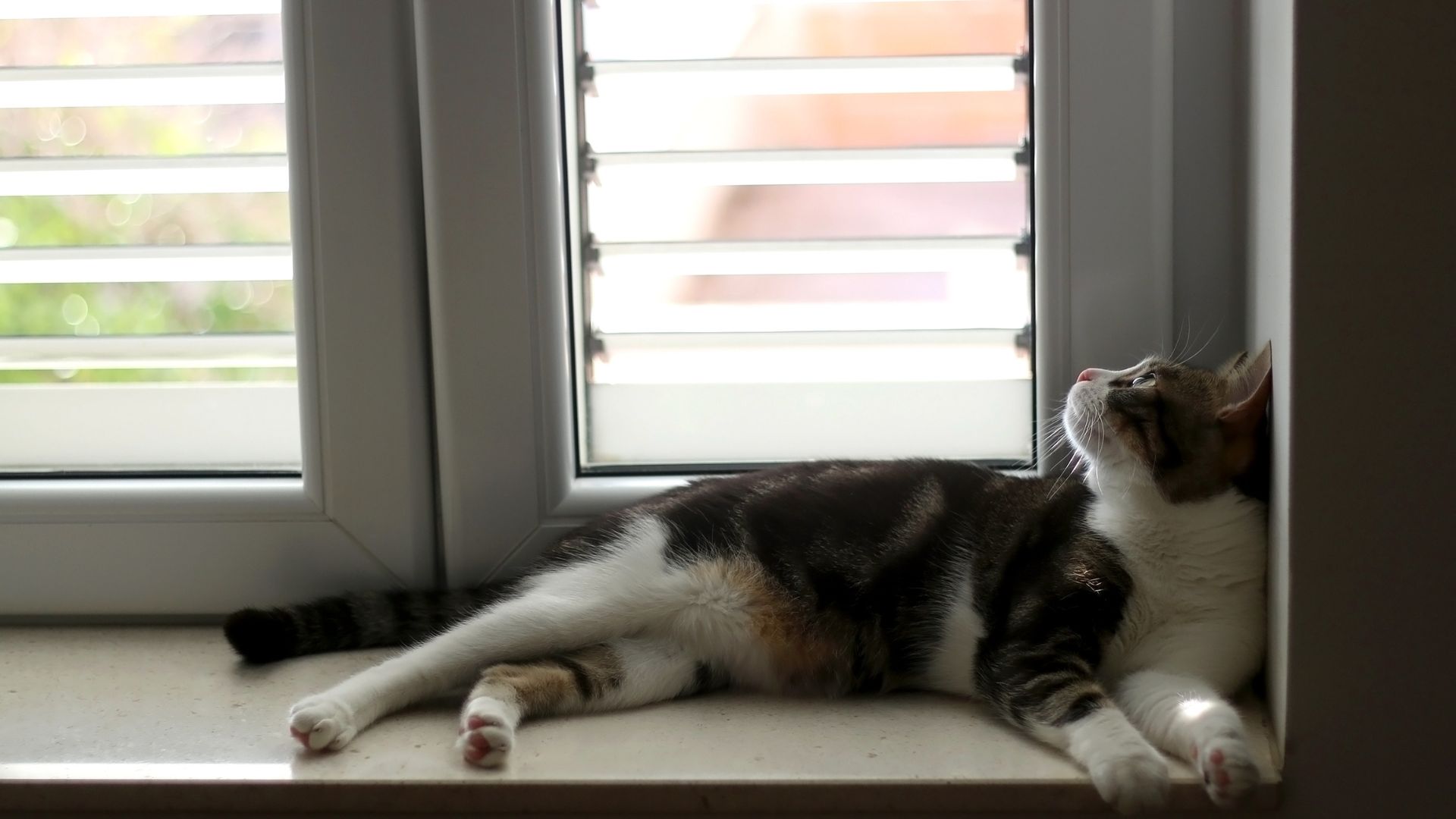
Indoor cats are safer than ever, and often more bored than we realize.
Many indoor cats spend large parts of the day sleeping, resting, or quietly watching the same rooms they’ve already memorized. To us, that can look like contentment. After all, they’re fed, warm, protected, and close by. What more could they need?
Does any of this sound familiar?
- Your cat gets bored of toys quickly
- Play works one day and falls flat the next
- They seem restless at night or amped up at inconvenient times
- They watch more than they actually engage
- You’re trying — but it doesn’t feel like it’s doing much
If so, it’s usually not because enrichment doesn’t work. It’s because a few small pieces aren’t lining up. This article covers all of them.
jump to…
But boredom in cats rarely looks dramatic. It shows up slowly, quietly, and in ways that are easy to miss, especially when routines don’t change for years at a time.
The Indoor Cat Problem (Quiet, Real)
It doesn’t always show up as destruction, aggression, or obvious misbehavior. More often, it shows up as subtle changes: less interest in toys that used to work, odd bursts of energy at inconvenient times, fixation on doors or windows, or a general sense that your cat seems “off” without being sick.
Because indoor cats are so good at adapting, it’s easy to assume that this is just how they are. That sleeping all day is normal. That being aloof or restless is just personality.
Sometimes it is. Often, it isn’t.
Indoor life narrows a cat’s world in ways we don’t always notice, especially when routines stay the same for years. That doesn’t mean indoor cats are unhappy, but it does mean they rely entirely on us to shape their world.
Interactive play is one of the most direct ways we do that. Not because cats need constant stimulation, but because play gives them something indoor life quietly takes away. Choice. Challenge. A sense of agency in an otherwise predictable day.
Why Interactive Play Matters for Indoor Cats
Interactive play supports indoor cats in several important ways. These are not flashy benefits or quick fixes. They are the quiet foundations that help indoor life feel more engaging, balanced, and responsive.
1. Interactive Play Breaks the Predictability of Indoor Life
Indoor cats live in environments that are safe but often highly repetitive. Interactive play interrupts that sameness and adds structure to time in a way food and rest alone cannot.
2. Play Helps Cats Express Natural Hunting Behaviors
Stalking, chasing, and pouncing are hardwired behaviors. Interactive play gives indoor cats a safe outlet for instincts that would otherwise have nowhere to go.
3. Interactive Play Strengthens the Human–Cat Bond
Play functions as a form of communication. It builds trust, shared rhythm, and familiarity in ways that passive coexistence does not.
4. Play Supports Physical Health in Subtle, Sustainable Ways
Indoor cats rarely get incidental movement. Interactive play encourages stretching, movement, and coordination without forcing activity or overstimulation.
5. Mental Engagement Matters as Much as Physical Movement
A cat can be physically tired and still mentally under-stimulated. Interactive play that involves anticipation and decision-making keeps the brain engaged, not just the body.
6. When Play Falls Flat, Timing and Variety Often Matter More Than Toys
Lack of interest in play is not always disinterest in engagement. Timing, predictability, and repetition often affect how play is received more than the toy itself.
7. Consistent Play Helps Reduce Stress and Misdirected Behaviors
Many behaviors labeled as problem behaviors stem from unspent energy or frustration. Interactive play provides a healthy outlet that helps regulate attention and stress over time.
All of these benefits point to the same underlying idea. Interactive play works best when it is part of a larger system, not a standalone fix. On its own, play can help. Paired with the right environment and daily rhythms, it becomes far more effective and far more sustainable.
What “Enrichment” Actually Means for Indoor Cats
When people hear “cat enrichment,” they usually think of toys.
Laser pointers. Wand toys. Puzzle feeders. Maybe a new scratcher or tunnel. Those things can help, but enrichment is bigger than playtime and far less flashy than most advice makes it sound.
For indoor cats, enrichment means mental engagement, choice, and variety built into everyday life. Research into feline behavior consistently points to the same conclusion: cats benefit most from environments that allow them to express natural behaviors, make choices, and interact meaningfully with their surroundings.
This is what enrichment actually looks like in an indoor cat’s life. Not elaborate setups or constant novelty, but intentional moments that break up sameness.
It’s the difference between burning off energy and giving a cat something to think about. Something to anticipate. Something that changes just enough to keep their world from feeling static.
Play is one part of that system, but it doesn’t work well on its own. Ten minutes with a toy doesn’t offset an environment that never changes, offers no observation points, and follows the same pattern day after day.
True enrichment for indoor cats usually includes a mix of:
- mental stimulation, not just physical movement
- opportunities to observe the outside world
- vertical or varied spaces to move through
- predictable routines paired with small novelty
- quiet places to disengage, not just places to play
None of this requires turning your home into an obstacle course or entertaining your cat constantly. In fact, overdoing it can backfire.
The goal isn’t to keep a cat busy all day. The goal is to make their indoor world feel alive.
Indoor Cat Enrichment Checklist
Before diving into specifics, a quick snapshot of what a well-rounded enrichment setup actually covers:
- Daily interactive play
- Vertical space to climb or perch
- Window or outdoor visual access
- Toys rotated, not left out permanently
- Quiet hiding or resting spots
- Mental challenge beyond food
- Predictable daily routine
Find this checklist useful? Save it on Pinterest.
Most cats don’t need all of these working perfectly at once. But when several are missing, it shows up in behavior.
Signs an Indoor Cat is Bored (Not Misbehaving)
Boredom in cats is really easy to misread.
Because indoor cats aren’t exposed to the same risks or stimuli as outdoor cats, their responses to boredom tend to be subtle, inconsistent, and often mistaken for personality quirks. A cat that seems aloof, needy, vocal, or restless isn’t necessarily being difficult. They may simply be under-stimulated.
Some common signs show up quietly over time:
- A sudden lack of interest in toys that used to work
- Short, intense bursts of energy at night or early morning
- Fixation on doors, cabinets, or specific areas of the house
- Excessive vocalizing, especially without an obvious cause
- Over-grooming, pacing, or hovering near people constantly
None of these behaviors automatically mean something is wrong. Cats are individuals, and changes can have many explanations. But when several of these patterns appear together — especially in cats whose routines haven’t changed — boredom is often part of the picture.
What makes this tricky is that bored cats don’t always look unhappy.
They may still eat well. They may still sleep most of the day. They may still seek affection. From the outside, everything can seem “fine,” even while their environment has become too predictable to hold their attention.
That’s why enrichment problems are often missed. We tend to notice obvious stress, not quiet disengagement.
Recognizing boredom isn’t about labeling your cat or blaming yourself. It’s about noticing small shifts and understanding that indoor cats depend entirely on their environment — and the people in it — to stay mentally engaged.
Once you start seeing these signs for what they are, the focus naturally shifts away from correcting behavior and toward improving the world your cat moves through every day.
Boredom vs. Stress: Why the Difference Matters
Not every behavior problem comes from boredom, and treating stress like boredom can make things worse.
The behavioral overlap between the two is real, but the underlying cause is different, and the response needs to match.
Bored cats tend to seek stimulation. They’re active in the wrong ways — knocking things over, chasing you, demanding attention, getting into things they normally ignore. Engagement usually helps. Add play, variety, and novelty and you’ll often see improvement within days.
Stressed cats tend to withdraw. They hide more, groom excessively, startle easily, or act tense around things that didn’t bother them before. More stimulation doesn’t fix this — it can amplify it. Stressed cats need predictability, safe retreat spots, and a reduction in whatever is triggering the tension.
The test is simple: if increasing engagement helps, it’s probably boredom. If it doesn’t, or makes things worse, something else may be going on — a change in the home, a health issue, or a stress trigger worth identifying.
When in doubt, a vet visit is the right call. Behavioral changes that appear suddenly or intensify quickly deserve a closer look.
Common Enrichment Mistakes
A lot of the time, it’s not that you’re not trying. It’s that a few common habits quietly work against you.
Leaving all the toys out all the time. Familiarity kills novelty. A toy that’s always on the floor becomes furniture. Rotating what’s available — even just swapping one toy out every few days — makes the same toys feel new again.
Only offering solo toys. Self-play toys have their place, but they don’t replace interactive play. Cats are wired for prey that moves unpredictably and responds to them. A wand toy operated by you delivers that. A ball on the floor usually doesn’t.
Playing without a clear end. When a play session fades out rather than finishing with a “catch,” cats can stay in a state of unresolved arousal. That’s often what drives the late-night zoomies or the ankle attack ten minutes after play. Wind sessions down intentionally — let them catch the prey, then slow the movement and stop.
Expecting cats to self-entertain. Most cats won’t self-motivate enrichment the way dogs might. They need the environment set up for them and someone to initiate interactive play regularly.
Ignoring vertical space. Floor-level living is limiting for a cat. Height gives them observation points, escape routes, and a sense of control over their space. A cat with no vertical options is working with a fraction of the enrichment potential of the room.
Why Play Sometimes Fails (Even When You’re Trying)
If you’ve ever bought a new toy, waved it enthusiastically, and watched your cat walk away, you’re not alone.
One of the most frustrating parts of trying to enrich an indoor cat’s life is feeling like you’re doing the “right” things with very little payoff. You play. You buy toys. You make a valiant effort and your cat still seems unimpressed or restless.
That doesn’t mean play doesn’t matter. It means play, on its own, is easy to get wrong.
Sometimes the timing is off. Cats are wired for short, focused bursts of activity, often tied to specific times of day. Playing when your cat isn’t naturally alert can feel pointless, even though the same activity might work perfectly at another time.
Sometimes the play itself becomes too predictable. Toys don’t need to be expensive to be effective, but they do need novelty. When the same movements, patterns, and objects show up day after day, cats quickly lose interest. What once felt exciting becomes background noise.
And sometimes play is simply expected to do too much work. A few minutes with a toy can’t fully compensate for an environment that never changes, offers limited observation points, or doesn’t allow a cat to make choices about where and how they spend their time.
This is where many well-meaning cat owners get discouraged. It’s easy to assume your cat is lazy, stubborn, or “just not playful.” In reality, the issue often isn’t effort — it’s context.
Play works best when it’s part of a broader enrichment picture, not when it’s treated as a standalone fix. Without mental stimulation, environmental variety, and a sense of control, even the best play sessions can fall flat.
Understanding why play sometimes fails helps take the pressure off. It shifts the focus away from finding the perfect toy and toward creating an indoor life that feels more dynamic, engaging, and responsive to how cats actually experience their world.
The Toy Rotation System
If your cat loses interest in toys quickly, the toy usually isn’t the problem. The pattern is.
Cats habituate fast. A toy that’s been sitting on the floor for two weeks isn’t a toy anymore — it’s part of the furniture. Rotating what’s available is one of the easiest and cheapest enrichment improvements you can make.
A basic rotation system:
Leave out: a few familiar favorites, one climbing or perch option, one solo-play toy your cat actually uses.
Put away after use: wand toys and feather toys (these lose their power quickly if left out), puzzle or treat toys, anything that’s been ignored for more than a few days.
Rotate: pull stored toys back out after a week or two. The same toy that got ignored last week can generate genuine interest after some time away.
The goal isn’t to have fewer toys, it’s to make the toys you have feel less predictable. Novelty is the point, and you can manufacture novelty without buying anything new.
Mental vs. Physical Stimulation: Why Both Matter
When people think about keeping a cat active, they usually focus on movement. Running, jumping, chasing, pouncing. Physical activity is important, but it is only half of the picture and often not the half indoor cats are missing most.
Mental stimulation is what gives physical activity meaning.
For cats, mental engagement comes from problem-solving, observation, anticipation, and choice. It is the process of watching birds through a window, tracking patterns of light and sound, navigating vertical space, or deciding where to settle at different times of day. These moments may look quiet from the outside, but they require attention and focus.
Physical play without mental engagement can burn energy without satisfying curiosity. That is why some cats can sprint through a play session and still seem restless afterward. Their bodies are tired, but their minds have not been challenged.
On the other hand, mentally engaging experiences do not always involve much movement at all. Watching activity outside, exploring a slightly rearranged space, or interacting with something unfamiliar can leave a cat more settled than a longer play session that feels repetitive.
The most effective enrichment usually blends both. Short bursts of physical play paired with opportunities to observe, investigate, and make choices throughout the day create a more balanced indoor life. One does not replace the other. They work together.
Understanding this distinction helps explain why enrichment does not always look energetic. Sometimes the most valuable stimulation is quiet, slow, and easy to overlook. That does not make it less important. It makes it better suited to how cats naturally engage with their world.
Enrichment Beyond Toys: Expanding the Indoor World
Toys are often treated as the main solution for bored indoor cats, but they are only one piece of a much larger picture.
For many cats, the most meaningful stimulation comes from their environment itself. Where they can sit. What they can see. How many choices they have throughout the day. A home that looks the same from every angle and offers the same experiences hour after hour can start to feel flat, even if toys are available.
Simple environmental changes often have more impact than adding new toys. Access to windows allows cats to observe movement, light, weather, and sounds that change constantly. Vertical spaces such as shelves, well-designed cat trees, or sturdy furniture give cats different vantage points and a sense of control over their surroundings. Quiet, tucked-away spots provide places to disengage and reset, which is just as important as stimulation.
Enrichment also comes from variety, not constant novelty. A slightly rearranged room, a new perch location, or rotating which spaces are accessible can refresh a cat’s environment without overwhelming them. These changes encourage exploration and attention in ways that feel natural rather than forced.
What matters most is not how much you add, but how flexible the space feels. Indoor cats thrive when their world offers options. Places to watch. Places to hide. Places to rest. When cats can move between these states easily, their days feel fuller even when nothing dramatic is happening.
Enrichment beyond toys helps explain why some cats seem content simply sitting in a favorite spot, watching the world go by. That quiet engagement is not inactivity. It is a sign that their environment is giving them something to do.
Window Enrichment
For many indoor cats, a well-set-up window spot delivers more daily stimulation than any toy you’ll buy.
What actually makes a window setup worth using:
- Clear outdoor view. Bird feeders, squirrels, or even foot traffic — anything that moves unpredictably gives a cat something to track.
- Comfortable perch at the right height. A perch that requires an uncomfortable jump won’t get used. Make access easy, especially for older cats.
- Safe distance from the glass. Cats startled by things on the other side of the glass need enough room to retreat without feeling cornered.
- Visual variety through the day. Morning light, afternoon shadows, evening activity — a window with changing conditions is more interesting than one with a static view.
- An easy retreat nearby. The spot should feel safe, not exposed. A cat that feels like they can’t escape it won’t use it comfortably.
This is one area where a small investment — a window perch, a bird feeder outside — pays off in sustained daily enrichment without ongoing effort.
Enrichment in Small Spaces
Limited floor space doesn’t limit how much enrichment is possible. It just changes the approach.
The principle in smaller homes: go vertical instead of horizontal. Floor space matters less to a cat than height and variety of levels. A single tall cat tree or a few wall-mounted shelves at different heights gives a cat more usable territory than a spread of floor toys.
Practical adjustments for small spaces:
- Wall-mounted or corner perches take up no floor space and add significant vertical territory.
- Compact cat trees with multiple levels serve better than wide, flat structures.
- Toy rotation matters even more when storage is limited — fewer toys out at once keeps the space from feeling cluttered and keeps novelty higher.
- Window access is the biggest multiplier. In a small home, a good window view effectively extends the cat’s world without adding anything to the room.
- Quiet retreat spots — a covered bed in a corner, space under a chair — reduce tension that can build in smaller spaces where escape from stimulation is harder.
Cats in small spaces aren’t at a disadvantage if the space is set up thoughtfully. The square footage matters less than the options available within it.
What Daily Enrichment Can Look Like Without Overhauling Your Life
Daily enrichment does not have to be complicated, time-consuming, or perfectly planned.
For most indoor cats, enrichment works best when it is woven into the rhythm of the day rather than treated as a separate task. Short moments of engagement, spaced naturally, often matter more than longer efforts that feel forced or inconsistent.
That might look like a brief interactive play session when your cat is naturally alert, followed later by quiet window time or access to a favorite perch. It might mean opening up a different room for part of the day, shifting where a cat chooses to rest, or simply allowing time for observation without interruption.
A realistic daily rhythm could include:
- Short interactive play session (5-10 minutes, timed to when your cat is naturally active)
- One quick mental challenge — a puzzle feeder at mealtime, a new smell to investigate
- Window time with something worth watching outside
- At least one toy rotation during the week so what’s available feels fresh
- A calm wind-down after play rather than stopping abruptly
What matters is not doing everything, but doing something consistently.
Indoor cats benefit from a mix of predictability and small variation. Familiar routines help them feel secure, while subtle changes keep their environment from becoming stagnant. Over time, these small moments add up. A cat that has opportunities to observe, explore, and make choices throughout the day is often more settled than one whose stimulation is limited to occasional bursts of play.
Enrichment is not about constant activity or entertainment. It is about supporting how cats naturally engage with their world. Quiet attention. Brief movement. Observation. Rest.
When enrichment is approached this way, it feels less like a task and more like something that naturally fits into everyday life with your cat.
Indoor cats depend on us not just for food and safety, but for the shape of their daily world. That can sound like a lot, but it does not require perfection or constant effort. Paying attention to how your cat moves through their space, what holds their interest, and when they seem most engaged is often enough to guide small, meaningful changes. Over time, those small shifts can make an indoor life feel fuller, calmer, and more satisfying for everyone involved.
Last updated: April 30, 2026
Originally published: September 19, 2005