

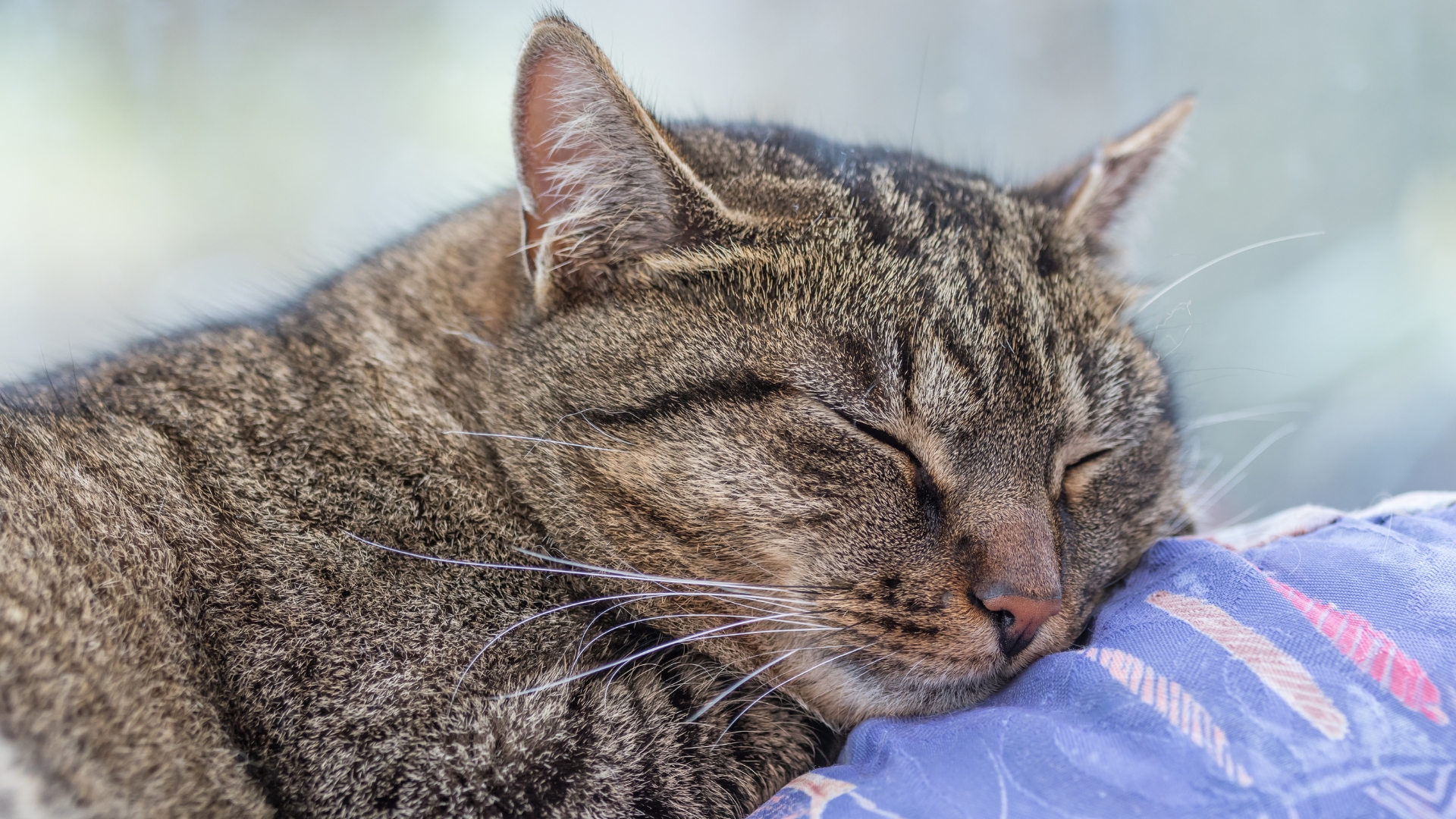
A cat with arthritis may still jump onto the bed every night. Maybe she pauses first now, or uses the chair to get there. Maybe the sunny windowsill doesn't get as much use, or you're finding tangles in a coat that used to stay tidy.
Signs of arthritis in cats often show up as changes in jumping, grooming, litter box habits, activity, or tolerance for being touched. An obvious limp may never be the thing that gets your attention.
Osteoarthritis is a degenerative joint disease that can cause chronic pain and make movement uncomfortable. It becomes more common as cats age. The thing worth watching isn't only what your cat has stopped doing. Sometimes the better clue is what they're still doing, but differently.
Why cat arthritis can be so easy to miss
Cats with arthritis don't have to be hobbling around the house.
In a prospective study of 28 cats with confirmed osteoarthritis, 71% had changes in their ability to jump and 67% had changes in jump height. The researchers concluded that overt lameness was not the most common clinical feature.
That's part of what makes it so easy to miss. The changes can look an awful lot like a cat who's simply getting older, lazier, grumpier, or a little messier. We find ordinary explanations for the little things: she doesn't seem interested in the cat tree anymore. He'd rather sleep downstairs these days. She's gotten picky about the litter box. Maybe he just doesn't like being picked up anymore. None of those changes necessarily screams “something hurts.”
Sometimes those explanations are right. But “getting old” by itself shouldn't make ordinary movement uncomfortable.
And when you live with the same cat every day, gradual changes are particularly hard to see. Today's slightly more careful jump doesn't look dramatically different from yesterday's. Six months later, the cat may have quietly rearranged much of the way they move through the house. We get used to their new routines right along with them.
Age matters, too. Joint changes become increasingly common in older cats, although arthritis seen on an X-ray doesn't necessarily tell us how much pain a particular cat is experiencing. And getting older doesn't mean every change in behavior or mobility should automatically be blamed on arthritis.
Watch how your cat jumps and gets around
Jumping changes are one of the most useful things to watch for.
Your cat may hesitate before jumping, make several little adjustments before taking off, or start using intermediate surfaces. Instead of jumping from the floor to the bed, maybe it's floor to chair to bed. A favorite high perch may be replaced by a lower one. Stairs may be taken more slowly.
Don't forget to watch the trip back down. Jumping down puts different demands on the body, and a cat may hesitate at the edge, look for a lower landing point, or choose a different route entirely.
The important thing isn't whether your cat can still get somewhere. Watch how much effort it takes.
Cats are also remarkably good at solving their own mobility problems. The chair beside the bed may quietly become a step. The coffee table may become the new route to the couch. Your cat may still reach all the same destinations, which makes it easy to think nothing has really changed.
Sometimes the new route is the clue.
Old phone videos can be surprisingly helpful here. Compare how your cat moved six months or a year ago with how they move now. You can also record ordinary movement at home to show your veterinarian. Don't coax your cat into making a difficult jump just to get it on video.
Grooming and scratching can change
A cat with sore joints may have trouble twisting, bending, or reaching certain parts of the body. Grooming may become less thorough, particularly around the back, hips, or hindquarters, and a coat that was always immaculate may start looking a little rough or develop tangles.
Some cats may lick or fuss with a painful area more rather than grooming less. Scratching habits can change too, and claws may become overgrown if a cat isn't using scratching surfaces the way they once did.
The useful comparison isn't your cat against some imaginary “normal” cat. It's your cat against themselves.
If your cat has never been a meticulous groomer, a slightly scruffy coat isn't especially revealing. If the cat who has spent 12 years keeping every hair in place suddenly stops reaching part of her back, that's worth noticing.
Litter box trouble can be a mobility clue
Using a litter box requires more movement than we sometimes realize. A cat has to step over the entrance, turn around, balance, squat, cover what they've done, and step back out.
A sore cat may start eliminating right beside the box, hanging over the edge, standing in an unusual position, or choosing a different box in the house. A cat who has always had impeccable litter box habits may suddenly look “messy.”
That doesn't mean a litter box problem should automatically be blamed on arthritis. Urinary disease, constipation, kidney disease, diabetes, stress, and other medical problems can change litter box habits too.
If your cat repeatedly strains to urinate and produces little or no urine, treat that as an emergency. A urinary blockage can become life-threatening quickly and needs immediate veterinary care.
For less urgent changes, pay attention to how your cat is using the box. Trouble stepping inside, an unusually high or awkward squat, difficulty turning around, or choosing the lowest-entry box in a multi-cat household can all be useful information to share with your vet.
Play, sleep, touch, and social habits may change too
A cat who hurts may play less, sleep more, spend more time alone, or become less tolerant of being picked up or touched around certain areas.
Even settling down can look different. A cat who once simply curled up may circle longer, lower themselves carefully, shift positions several times, or seem to have trouble getting comfortable. Getting back up after a long nap may look stiff or deliberate too.
These changes can be subtle because none of them belongs exclusively to arthritis. Cats sleep more for many reasons. Personalities change. Preferences change.
Again, the change from your cat's normal is what matters.
A cat who has hated being picked up since kittenhood isn't giving you a new arthritis clue by complaining about it at age 14. A cat who has happily been scooped up for years and suddenly flinches, stiffens, growls, or tries to escape is telling you that something has changed.
Look for what's different, not just what your cat can still do
This may be the most useful way to think about arthritis in cats.
- “She still gets on the bed.”
- “He still goes upstairs.”
- “She still uses the litter box.”
All of those things can be true while the way the cat accomplishes them has changed.
Maybe she gets onto the bed using the chair now. Maybe he pauses halfway up the stairs. Maybe she still uses the litter box but no longer squats the same way. Maybe the cat who still climbs onto the sofa has stopped visiting the top of the cat tree.
Cats can adapt remarkably well to bodies that don't move as easily as they once did. Those adaptations can hide the problem because, from our perspective, the cat is still getting where they want to go.
This is also why gradual changes can be easier to recognize in hindsight. Owners sometimes don't realize how much activity their cat had given up until pain is being managed and an old behavior returns: climbing onto a familiar perch, playing again, grooming more comfortably, or simply moving around the house more freely.
That doesn't tell you what treatment a particular cat needs. It does show why having a few concrete benchmarks can be more useful than trying to decide whether a cat generally seems “better” or “worse.”
These signs don't automatically mean arthritis
Less jumping, a messy coat, a litter box accident, or a personality change doesn't diagnose osteoarthritis.
Many conditions can cause similar changes, especially in older cats. Persistent changes in movement, grooming, appetite, litter box habits, activity, or behavior deserve a conversation with your veterinarian rather than an assumption that your cat is “just getting old.”
Be specific about what you've noticed. “She's slowing down” doesn't give your vet nearly as much information as “She used to jump directly onto our bed and now she always uses the chair first.”
Photos and short videos from home can help too, particularly because cats don't always move normally in an unfamiliar exam room.
Your veterinarian may recommend a physical examination and, depending on your cat and the symptoms, X-rays, bloodwork, urine testing, or other diagnostics. Bloodwork doesn't diagnose arthritis, but it can help identify other health problems and may matter when your veterinarian is considering treatment options.
Sudden inability to stand or use a leg, significant weakness, repeated urinary straining, breathing difficulty, or other severe and abrupt changes aren't “watch and wait” signs. Seek veterinary care promptly.
Make everyday life easier while you figure it out
You don't need to remodel the house or buy a pile of “senior cat” products. Start with whatever your cat seems to be having trouble using.
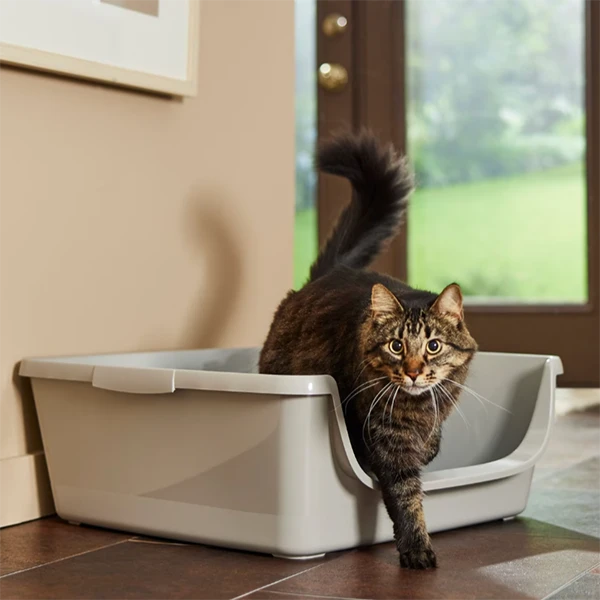
Make the litter box easier to enter. A lower entrance can help if stepping over the side has become uncomfortable. Size matters too. Your cat still needs enough room to get inside, turn around and find a comfortable position. Higher sides around the rest of the box can help contain litter and urine, especially if your cat isn't squatting as deeply as they used to.
Worth a look: Frisco Senior XL Litter Box
This one combines a low 3.5-inch entrance with a genuinely roomy floor, so there’s space to turn and reposition without stepping over a high side first.
The other three sides are 9 inches high, helping with containment without making the entrance harder to step over.
At about 23.5 × 23.5 inches, it’s a big box, so check that you have the floor space before ordering.
Whatever box you choose, don't change everything at once. If your cat is particular about litter boxes, keeping the familiar box available while introducing an easier one can make the transition less stressful.
Create an easier route to favorite places. Stable pet steps, a ramp, an ottoman, or another intermediate surface can reduce the size of a jump. Stability matters: a wobbly set of steps isn't much help to a cat who already feels uncertain about moving.
And remember that the cat gets a vote. Some cats happily use the beautiful pet stairs you bought for them. Others ignore them and decide that a sturdy stool or strategically placed chair is obviously the superior solution. Before rearranging the whole house or buying several mobility products, watch what your cat is willing to use.
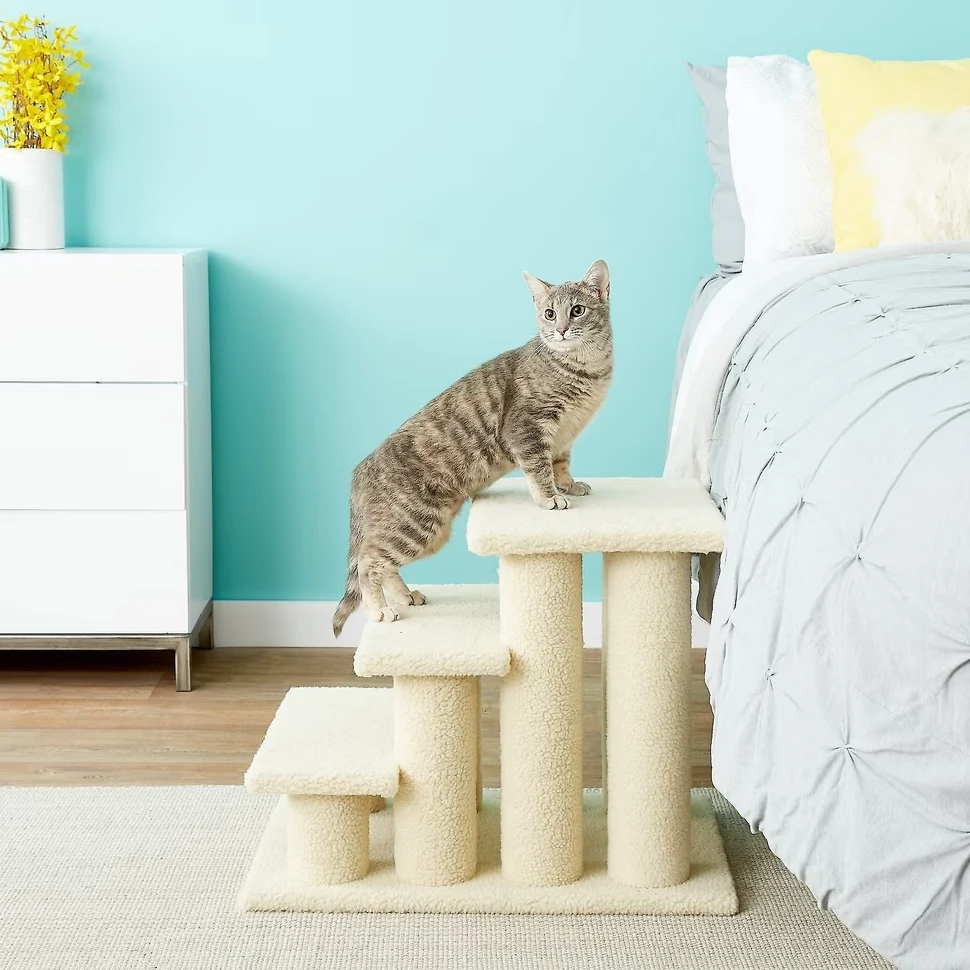
Worth a look: Frisco 2-in-1 Pet Steps
Frisco 2-in-1 Cat & Dog Stairs on Chewy
These can be assembled with either three or four steps, which gives you some flexibility to match the stairs to a couch, bed, or favorite perch. Each step has a 6-inch rise, turning one big jump into a series of smaller movements.
We also like that these aren't lightweight foam steps. They weigh about 23 pounds, have a non-skid design and a soft faux-fleece surface, and can support pets up to 120 pounds. In the four-step setup they're about 24.75 inches high, with a footprint of roughly 23.5 × 17 inches.
Offer an easy place to rest. Soft, supportive bedding in an accessible location may be more inviting than a favorite bed that now requires a difficult jump. A pet-safe heated bed or warming pad can be another option, as long as your cat can easily move away from the heat.
Make food and water easy to reach. Avoid requiring difficult jumps to get to everyday necessities. In homes with dogs or multiple cats, this may take a little creativity if food has traditionally been kept on a counter or other elevated surface.
Add traction where it matters. Slick flooring can make movement harder. A non-slip mat or runner along a frequently traveled route may give an older cat more confidence and stability.
Help with the things your cat isn't managing as well. That may include more frequent nail checks or gentle help with grooming areas they can no longer reach comfortably. Stop if handling seems painful and ask your vet for help when needed.
None of these changes treats the underlying pain of arthritis. They simply remove some unnecessary physical hurdles from everyday life.
And sometimes the cheapest solution works perfectly well. The goal isn't to make your house look like it belongs to a senior cat. It's to make the things your cat still wants to do easier to do.
What if your vet thinks it is arthritis?
Feline arthritis can be managed, and your veterinarian can help you decide which options make sense for your individual cat.
Depending on your cat's health, age, weight, other medical conditions, and degree of discomfort, that conversation may include prescription pain management, injectable medications, therapeutic diets, weight management, rehabilitation or physical therapy, and changes at home.
There is enough nuance in those choices to deserve a separate discussion.
One thing you can do now is establish a few ordinary benchmarks. Can your cat get onto the bed without hesitation? How are the stairs going? Are they grooming their back? Playing? Using the litter box comfortably?
Those everyday behaviors give you and your vet something concrete to compare over time.
Never give your cat human pain medicine on your own
Don't give your cat acetaminophen (Tylenol), ibuprofen, naproxen, or another human pain medicine unless your veterinarian has specifically instructed you to do so.
Several common human pain medicines can be extremely dangerous to cats.
If your cat has swallowed or been given a human medication, contact your veterinarian or an emergency veterinary clinic right away. You can also contact ASPCA Animal Poison Control at 888-426-4435. A consultation fee may apply.
A cat who stops coming onto the bed may still want to be there. The cat who starts using a chair to reach the windowsill may still love that sunny spot just as much. Small changes like these are easy to dismiss as aging or simply a new habit, but they're worth paying attention to.
You know your cat's normal routines better than anyone. If the way they jump, groom, use the litter box, play, or move around the house has changed, bring those observations to your veterinarian. A few notes, photos, or short videos from home can help show what's happening outside the exam room.
Sometimes the first sign that something hurts is simply finding a new way to reach the places that still matter.
Sources
U.S. Food & Drug Administration. Osteoarthritis in Cats: More Common Than You Think.
https://www.fda.gov/animal-veterinary/animal-health-literacy/osteoarthritis-cats-more-common-you-think
Clarke SP, Bennett D. Feline osteoarthritis: a prospective study of 28 cases. Journal of Small Animal Practice. 2006.
https://pubmed.ncbi.nlm.nih.gov/16911111/
Lefort-Holguin M, et al. Osteoarthritis in cats: what we know, and mostly, what we don't know… yet. Journal of Feline Medicine and Surgery. 2025.
https://pmc.ncbi.nlm.nih.gov/articles/PMC12277680/
International Cat Care. Changes to the home environment for cats with muscle/joint pain or mobility problems.
https://icatcare.org/resources/cat-carer-guide-changes-to-the-home-environment.pdf
Cornell Feline Health Center. Feline Lower Urinary Tract Disease.
https://www.vet.cornell.edu/departments-centers-and-institutes/cornell-feline-health-center/health-information/feline-health-topics/feline-lower-urinary-tract-disease
ASPCApro. Common Feline Toxic Exposures and Their Treatment.
https://www.aspcapro.org/resource/common-feline-toxic-exposures-and-their-treatment