

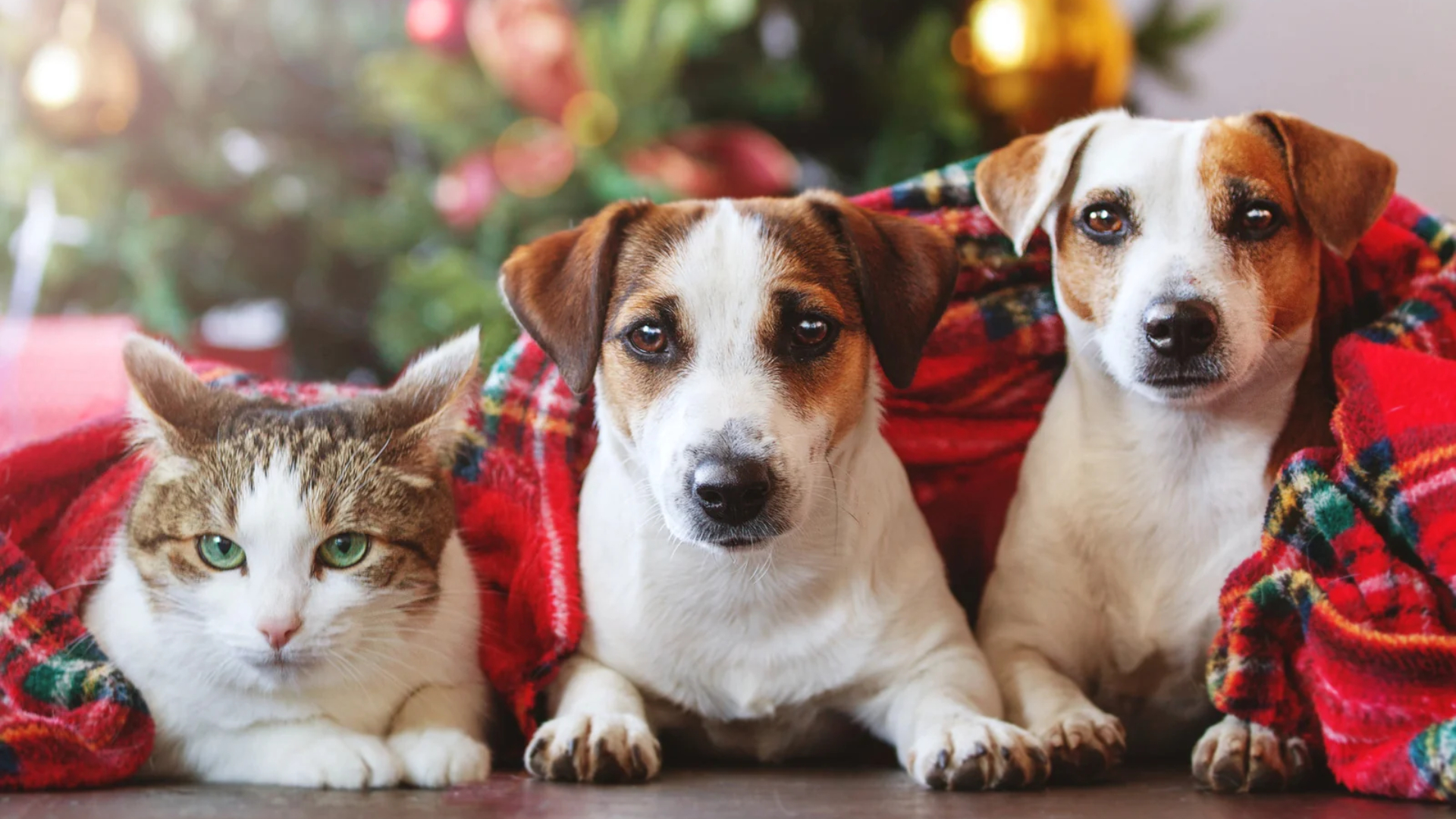
Quick answer: Common holiday pet emergencies include food (chocolate, xylitol, grapes and raisins, onion-heavy dishes, and fatty scraps), swallowed decorations (tinsel, ribbon, ornaments), lilies in holiday bouquets for cats, and pets slipping out a busy front door. Secure the tree, keep string-like decorations away from cats, keep food off low surfaces and out from under the tree, give pets a quiet room, and save a pet poison line number in your phone.
The tree goes up, and within an hour somebody has found the lowest branch. For a cat, it’s the best climbing structure that’s ever appeared indoors. For a dog, it’s a new smell and possibly a water bowl. Neither is a reason to skip the tree. It just means the season works better with a little planning, starting with the thing most likely to fall over.
The tree
A tree that can’t tip over is a good place to start. Cats climb, and big dogs bump, wag, and lean.
- Anchor it. A sturdy stand is the start. For an extra safeguard, tie the top of the tree to a wall or ceiling hook with clear fishing line.
- Cover the water. Tree water can hold fertilizer, preservatives, and bacteria. It usually causes only mild vomiting or diarrhea, but there’s no reason to let it become a second water bowl. A tree skirt or a cover over the stand helps.
- Skip preservatives in the water if your pets can reach it at all.
- Sweep up needles. Chewed needles irritate the mouth and stomach and can cause vomiting and drooling. In large amounts they don’t digest well and can cause a blockage.
- Unplug the lights when nobody’s home. Chewed cords can shock or burn, and a cat tangled in a lit strand is a bad combination.
- Decorate in layers. Breakable and tempting ornaments go up high. The bottom third of the tree is for unbreakable ornaments, or nothing at all.
- Artificial trees aren’t hazard-free. Chewed artificial needles can also upset the stomach or cause a blockage if enough goes down.
If you have a young cat who treats the tree as a jungle gym, some people simply give up on the bottom branches for a year. That’s a reasonable trade.
Decorations
For cats, tinsel and ribbon are the big one. They aren’t poisonous. The danger is the shape. A long piece of string, tinsel, or ribbon can anchor under the tongue or in the stomach while the rest moves on, and the intestine bunches up around it. Vets call this a linear foreign body, and it often needs surgery.
If you see string or tinsel hanging from your pet’s mouth or rear end, don’t pull it. Pulling can do serious internal damage. Call your vet right away.
Other decorations worth a second look:
| Decoration | Why it matters | What to do |
|---|---|---|
| Tinsel, ribbon, and gift string | Can cause a linear foreign body, especially in cats | Skip tinsel; pick up ribbon as gifts are opened |
| Salt dough ornaments | Very high in salt. Eating them can cause salt poisoning, which can be fatal, especially in smaller dogs | Hang them high, including the ones the kids made years ago, or keep them in a closed display |
| Glass ornaments and hooks | Cuts to the mouth and gut; hooks can be swallowed | Breakables up high; collect stray hooks |
| Electrical cords | Shocks and mouth burns | Route behind furniture or use cord covers |
| Batteries | Can burn the mouth, throat, and stomach | Store spares closed; watch remotes and new toys |
| Snow globes | Some contain ethylene glycol, the same chemical in antifreeze | Keep out of reach; clean up a broken one fast |
| Bubble lights | The liquid inside can be harmful if chewed open | Keep away from chewers |
| Liquid potpourri and essential oils | Even a few licks can burn a cat’s mouth; cats process these oils poorly | Skip simmering potpourri in a cat house |
| Lit candles and menorahs | Burns and fire from a tail or a curious paw | Stable holders, high surfaces, never unattended. LED candles are easier. |
Birds are sensitive to anything in the air, so keep scented candles, sprays, and simmering potpourri well away from them.
Holiday plants: how worried should you be?
Poinsettias get the bad reputation. Lilies deserve it. Here’s how the common holiday plants actually compare for dogs and cats.
| Plant | How serious | What to know |
|---|---|---|
| Lilies (true lilies and daylilies, common in holiday bouquets) | Emergency for cats | Any part, including pollen and vase water, can cause kidney failure in cats. Don’t bring them into a house with cats. More in our lilies and cats guide. |
| Amaryllis | Moderate | Leaves and flowers cause vomiting and drooling. The bulb is more toxic and can cause tremors or seizures in large amounts. |
| Mistletoe | Mild to serious, depending on amount | A few leaves or berries usually means an upset stomach. Larger amounts can affect heart rate and blood pressure. European varieties are more concerning than American. |
| Holly | Mild to moderate | Berries are the most toxic part. Expect drooling, vomiting, and diarrhea, plus head shaking from the spiky leaves. |
| Cyclamen | Mild (leaves) to serious (roots) | Leaves and flowers upset the stomach. The roots and tuber are far more toxic. |
| Christmas rose (hellebore) | Moderate | Can cause heavy drooling and stomach upset. |
| Poinsettia | Mild | The sap can irritate the mouth and stomach, causing drooling or vomiting. It usually clears up on its own. Still not a chew toy. |
The simplest route is silk or plastic greenery, or flowers you’ve confirmed are safe for pets. If a real plant arrives as a gift, put it somewhere your pets truly can’t reach, or pass it along.
The table and the kitchen
Keep your pets on their regular food and ask guests not to share theirs. Most of the danger comes from foods that are perfectly normal for people.
| Food | Why it’s dangerous | Watch for it in |
|---|---|---|
| Chocolate | Contains theobromine and caffeine. Dark and baking chocolate are the most dangerous. | Gift boxes, advent calendars, baking supplies, cocoa |
| Xylitol (also sold as “birch sugar”) | Can cause a fast, dangerous drop in blood sugar and liver failure in dogs | Sugar-free candy, gum, mints, some baked goods and peanut butters |
| Grapes, raisins, and currants | Can cause kidney failure in dogs, with no known safe amount | Fruitcake, stuffing, cookies, holiday breads |
| Onions, garlic, leeks, and chives | Damage red blood cells and can cause anemia. Cats are more sensitive than dogs. Cooking and powdering don’t make them safer. | Stuffing, gravy, casseroles, mashed potatoes |
| Raw yeast dough | Keeps rising in the stomach and produces alcohol as it ferments | Rolls and bread left out to rise |
| Macadamia nuts | Can cause weakness, tremors, and fever in dogs | Cookies, nut mixes, chocolates |
| Fatty scraps and skin | Can trigger pancreatitis, a painful and sometimes life-threatening condition | Turkey skin, ham fat, gravy, butter |
| Cooked bones | Splinter and can injure the mouth and gut | Leftover platters, the trash |
| Alcohol | Can make pets very sick, even comatose | Eggnog, punch, rum-soaked cakes, unattended glasses |
A few habits that cover most of it:
- Clear plates fast and don’t leave a buffet unattended at nose height.
- Use a trash can with a lid, or take the bag out right after dinner. The turkey carcass is the most tempting thing in the house.
- Let dough rise somewhere closed, like the oven (off) or a microwave.
- Tell guests, especially kids, that the pets don’t get table food. People sneak scraps out of kindness.
Guests and a busy house
Even a social dog or cat can get overwhelmed by a full house. New people, new noise, and a door that keeps opening add up.
- Set up a quiet room before people arrive: water, a bed, a litter box for cats, and something to chew or a food puzzle for dogs. Pets can retreat there whenever they want, and spend the loudest stretch of the party there.
- Watch the front door. Arrivals and departures are when pets slip out. Check that collar tags and microchip contact info are current before the holidays, not after a pet goes missing.
- Ask overnight guests to keep medications zipped away. An open suitcase or a pill organizer on a nightstand is easy for a curious pet to get into. Same goes for purses and coat pockets with gum or mints.
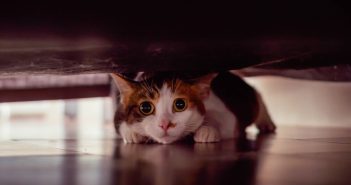
- Let shy pets choose. A cat under the bed is handling it. If your cat tends to vanish when company comes, our guide on why cats hide from guests covers what helps and what doesn’t.
Gifts and wrapping
- Don’t put wrapped food under the tree. Dogs can smell a box of chocolates through paper and will open it for you. That includes gifts you didn’t wrap yourself, so ask people what’s in theirs.
- Pick up paper and ribbon as you go. Foil wrap and ribbon can cause blockages.
- Check what came with the toys. Small parts and button batteries get swallowed.
- Choose pet gifts that can’t be swallowed. For cats, think a ball too big to swallow, a catnip toy, or a wand toy you put away afterward. Skip string toys left out unsupervised.
- Think twice before giving a live pet as a surprise. A collar or leash with a promise of a shelter visit lets the person choose their own match.
New Year’s Eve
- Plan for the noise. Fireworks, poppers, and noisemakers frighten many pets. Put them in a secure, escape-proof room well before midnight, with music or a fan running.
- Walk dogs early, before neighborhood fireworks start.
- Clean up afterward. Confetti, popper strings, and balloon pieces are all swallowable, and champagne glasses left on low tables are an alcohol risk.
If your pet panics every New Year’s, talk to your vet well before December. There are options, and they work better with some lead time.
What to do if your pet eats something
Call right away. Don’t wait for symptoms. With many holiday toxins, including xylitol, grapes, and lilies, early treatment matters most.
- Call your vet or the nearest emergency vet clinic.
- Or call a pet poison line, both open 24/7. Each charges a consultation fee.
- ASPCA Animal Poison Control: (888) 426-4435
- Pet Poison Helpline: (855) 764-7661
- Have this ready: what your pet ate, about how much, roughly when, and your pet’s weight. Keep the package or wrapper.
- Don’t make your pet vomit unless a vet tells you to.
- Don’t pull on string or tinsel you can see. Get to the vet.
Save both numbers in your phone now, before you need them.
Holiday checklist
- Tree anchored, water covered, lights unplugged when you’re out
- Tinsel skipped; ribbon picked up as gifts are opened
- Breakable and salt dough ornaments up high
- No lilies in a house with cats
- No wrapped food under the tree
- Trash can with a lid; dough rising somewhere closed
- Guests know: no table food, medications zipped away
- Quiet room ready before people arrive
- Tags and microchip info current
- Escape-proof room for New Year’s noise
- Poison line numbers saved
When the tree finally comes down in January, the cat will look personally offended. That’s a good holiday.
Written by the PetsBlogs editorial team, drawing on current guidance from the ASPCA, Pet Poison Helpline, AVMA, FDA, VCA Animal Hospitals, and Best Friends Animal Society. It isn’t a substitute for your veterinarian. If your pet may have eaten something toxic, call your vet or a poison line right away.
Last updated: November 18, 2026
Originally published: December 16, 2011
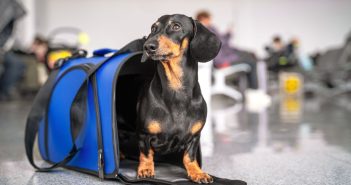
One of my favorite pet safety products is the PupLight Collar. There is a giveaway for it going on right now :)cleverblog.isntthisclever.com/2011/12/20/holiday-pet-gift-giveaway-puplight-collar
it is really important for the pets to be safe specially during the holidays, they should be equally as happy as we are.
These are Very great tips have to keep Pet Safety tips in mind Thanks for sharing