

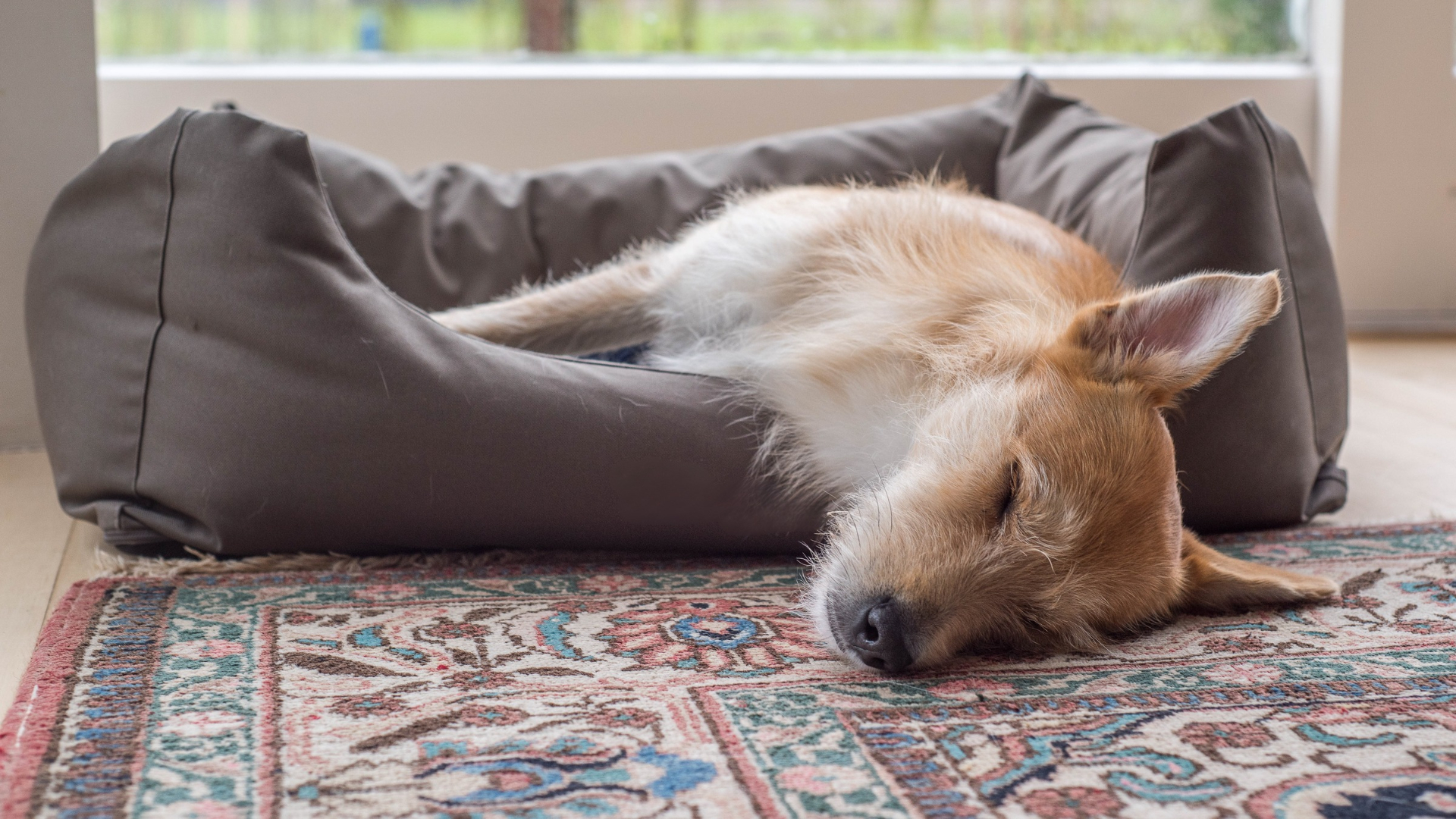
Who benefits most and why
The short answer: Not necessarily. Dogs can sleep on almost anything, and plenty of them sleep on our beds with us. But a dog also spends a big part of every day asleep, and most of that happens away from your bed, on whatever floor, rug, or couch cushion is handy. For big dogs, older dogs, and dogs who flop down on tile or hardwood, a good bed (or at least a good padded spot) protects their elbows and joints that a hard floor wears down over time.
Your dog’s bed isn’t competing with yours
If your dog sleeps with you, you’re in good company, and the research is kinder about it than the old advice was. A 2017 Mayo Clinic study followed 40 adults who slept with a dog in the bedroom, with people and dogs both wearing activity trackers for a week of nights. People slept well overall. Sleep efficiency (time asleep compared to time in bed) dipped slightly when the dog was on the bed, about 80 percent versus 83 percent with the dog elsewhere in the room, and both numbers land in the range sleep researchers consider satisfactory. And in case you were wondering, the dogs slept just as well either way.
So none of this is a case for kicking anyone off the bed. It’s all about the rest of the day.
Most adult dogs sleep somewhere between 8 and 13.5 hours out of every 24, averaging just under 11, according to the Sleep Foundation. And they don’t do it all at once. Dogs sleep in cycles: overnight, plus a string of naps after walks, after meals, and whenever the house goes quiet. Those naps happen wherever they land. The kitchen tile, the hallway, the porch, the patch of sun by the back door.
That’s where a dog bed earns its keep.
What hard floors actually do
For a young, mid-sized dog who naps on carpet and the couch, maybe nothing worth worrying about. For big dogs, the floor slowly leaves its mark.
Every time a heavy dog lies down on hardwood, tile, or concrete, their weight lands on a few bony points, mostly the elbows. Over months, the skin there toughens into a callus: a gray, hairless, leathery patch. Sometimes it goes further. VCA’s veterinarians describe a hygroma as a fluid-filled swelling that forms over a bony spot, usually the elbow, in response to that repeated pressure. They note that any large- or giant-breed dog, of any age, is at risk if they spend time resting and sleeping on hard surfaces. Hygromas often start small and painless, but they can become infected, and at that point it’s a vet problem.
There’s a seasonal wrinkle, too. One VCA veterinarian notes that elbow hygromas seem to show up more in summer, when dogs seek out cool tile and concrete. The cool floor feels good. It’s just hard.
Which dogs benefit most from a good bed
| Dog | Why a bed matters |
|---|---|
| Large and giant breeds | More weight landing on the same small elbow every time they lie down |
| Senior dogs | Stiffer joints, slower to get up, and often thinner padding over the bones |
| Dogs with arthritis or hip trouble | A supportive surface makes it easier to get comfortable, and easier to get back up |
| Short-coated big dogs | Very little natural cushioning between bone and floor |
| Dogs recovering from surgery or injury | They need somewhere comfortable to stay put while they heal |
| Dogs who live on hard floors | No carpet, no rug, and no couch privileges means the floor is the default |
If your dog is young, medium-sized, and already sleeps on carpet, a rug, and your couch, they’re probably fine without anything fancy. A bed is still nice to have. It’s just not urgent.
Match the bed to how your dog sleeps
Before you buy anything, watch how your dog actually sleeps for a few days. It tells you more than any product description.
| If your dog… | Look for |
|---|---|
| Sprawls flat out, legs everywhere | A flat, rectangular or mattress-style bed big enough to stretch out completely |
| Curls up nose to tail | A round or bolster bed with an edge to lean into |
| Is older or stiff | Thick, firm foam with a low edge to step onto. Too soft and they sink, which makes getting up harder |
| Runs hot and hunts for tile | An elevated cot or a cooling bed. Memory foam holds heat |
| Likes to lean against something | A bolster on one or more sides |
| Spends a lot of time on the porch or outside | An elevated mesh cot that keeps them off hot, cold, or damp surfaces and hoses clean |
Shape matters more than people expect. Tom Candy, a clinical animal behaviorist at Dogs Trust UK, told AAHA’s Trends magazine that round, doughnut-style beds often don’t let a dog stretch out, and that good, deep sleep tends to look like a dog lying completely flat and fully stretched. A curler will happily use a donut bed. A sprawler crammed into one will probably end up on the floor next to it.
A porch setup that works for a big dog
For big dogs who spend a lot of time outside, an elevated mesh cot is hard to beat. My 120-pound dog has Coolaroo cots on both the front and back porch, including one set inside an enormous shelter. The mesh lets air move underneath in summer, keeps him off cold, damp boards in winter, and is easy to clean with a hose. When it turns cold, I add a couple of huge dog bed pillows below and on top of the cot. That gives him extra warmth and structure, and a cave to burrow into when he’d rather not be out in the open. Same cot, two seasons, depending on what he wants that day.

What my big dog sleeps on
Coolaroo Steel-Framed Elevated Dog Bed. He has been on these for years, front porch and back. Breathable mesh, a steel frame, and easy to clean with a hose. The little dogs, and the occasional cat, like it too. It comes in Small through X-Large, and for a big dog I go with the X-Large.
I have three of these. When the mesh wears out, you can get a replacement cover and put it on the same frame instead of buying a whole new cot. I’ve worn out a few frames too, so they’re not forever, but they earn their keep.
Smaller dog or tighter budget? Chewy’s Frisco version is the same idea in sizes up to Large.
Where you put the bed matters as much as the bed
A great bed in the wrong spot is a bed nobody uses.
Two things tend to matter: quiet and company. In a 2022 survey of 1,330 people about their dogs, published in the journal Animals, dogs who were easily startled awake by footsteps or passing cars had worse problem-behavior scores than dogs who slept through that noise. A bed in a hallway or next to the back door, where people walk past all day, is a bed that keeps getting interrupted.
At the same time, most dogs want to be near their people. A bed tucked away in an empty back room often goes unused. The sweet spot is usually a quiet corner of a room where people actually spend time: close enough to see you, out of the traffic.
Why your dog lies right next to the nice new bed
It happens to all of us. You bring home a beautiful bed, set it down, and your dog stretches out on the floor six inches away. Usually there’s a reason.
| What’s going on | What to try |
|---|---|
| Too warm | A cooling bed or cot, or a thinner bed in summer |
| Wrong shape | A sprawler needs a flat bed, not a donut |
| Wrong spot | Move it to where your dog already likes to hang out |
| Too soft to get out of | Firmer foam, especially for older dogs |
| Smells new | Put an old blanket or a worn T-shirt on it for a few days |
| They just have a spot | Bring the padding to the spot |
That last one is more common than you’d think. Some dogs pick a rug, a corner of the porch, or the exact spot in front of the fridge, and that’s where they’re going to sleep. If that’s your dog, meet them where they flop.
A thick rug, a folded blanket, or a padded mat in their favorite spot does a lot of the same work as a bed. The padded kitchen mats you’d stand on at the sink are great for this. I’ve also used interlocking foam floor tiles, the gym kind, for temporary puppy areas. They’re cheap, they cut to fit, you can pull up one square to clean it, and they take the edge off a hard floor fast. If the spot is a thin rug, a thick rug pad underneath turns it into a real cushion without moving anything. And for porches, garages, or barn aisles, rubber stall mats hold up to anything.
| Idea | Why it works |
|---|---|
| Anti-fatigue kitchen mat | The cushioned mat you’d stand on at the sink. Look for a non-slip back and a surface that wipes clean, and skip ones with loose or peeling edges if your dog chews |
| Interlocking foam floor tiles | Also called EVA foam or gym mats: puzzle-edge squares, usually ½ to ¾ inch thick, and thicker is better for big dogs. They cut to fit, and you can pull up one square to clean it. Watch puppies who chew, since swallowed foam is a vet problem |
| Thick rug pad under their rug | Turns a thin rug into a real cushion without moving their spot |
| Moving blanket folded in thirds | Thick, tough, and washable for a few dollars |
| Old couch cushion or crib mattress | Firm and flat, and crib mattresses often have waterproof covers |
| Rubber stall mat | Holds up on porches, garages, and barn aisles, and much easier on joints than concrete |
The goal was never really the bed. It’s keeping your dog off bare, hard floor for hours at a time. A thin decorative rug over hardwood helps less than it looks like it would, especially for a big dog, so if the rug is the spot, put something with real cushion on or under it, like those listed above.
And sometimes they do use the bed, just not the way the product photo pictured it. Half on and half off. Chin hooked over the bolster, body on the floor. Upside down with all four legs in the air. It still counts.
Signs your dog’s bed isn’t doing its job
- The press test fails. Push your palm or a knee into the middle of the bed. If you can feel the floor, so can your dog.
- Elbow calluses are forming or getting bigger.
- Your dog sleeps beside the bed, not in it.
- They’re stiff or slow getting up after a long nap.
- They shift and resettle a lot instead of sleeping stretched out.
Beds wear out. Cheap fiberfill flattens fast, and even good foam breaks down eventually. Once a bed has gone flat, it’s basically a cushion-shaped rug.
When it’s a vet question, not a bed question
A better bed helps with comfort. It doesn’t diagnose or fix anything. Call your vet if you notice:
- A soft swelling on an elbow or another bony spot
- A callus that cracks, bleeds, or oozes
- New stiffness, limping, or trouble getting up
- Nighttime pacing, whining, or a dog who seems to have flipped day and night. AAHA notes these are worth a vet visit, not just moving the dog to another room so everyone can sleep
Sometimes the bed is the fix. Sometimes it’s the thing that helps while your vet handles the rest.
Last updated: November 12, 2026
Originally published: November 14, 2011




Pet ownership is cited to have many benefits for humans. Owning a pet can help reduce stress, improve your emotional health and may even promote faster healing. However, keeping your pet in good health involves a lot of responsibility. Understanding how to care for a pet requires you to do a bit of research beforehand. Your pet needs to have a proper diet, grooming, a place to sleep, proper training, social interaction and may other things in order to be happy. This is very nice post. I like it. thanks for the informative post.
Snoozes for dogs or any other pets are relatively important for a healthy body. The time spent for sleeping affects how they respond to their day to day activities.
Like humans, pets also would love luxury. Pets are happier when they are in luxury. Peaceful and comfortable sleep would make them healthier and stronger.
Great post. Good information. I agree with you that the health of the dog requires a peaceful, stress free place to retreat to. A good quality dog bed to rest on is a must have item for the happiness and health of as you said “Man’s Best Friend”.
Memory foam dog beds are the best answer for pets suffering from bone, hip or joint problems that need a good nights sleep. When this foam is used in therapeutic dog beds, it provides excellent support to the pressure points like the spine, hips, shoulders and legs. For an aging or arthritic dog, this can provide much support and pain relief. Memory foam pet beds have an open-cell structure that reacts to body heat and weight by ‘moulding’ to your pets body, helping relieve pressure points, preventing pressure sores.