

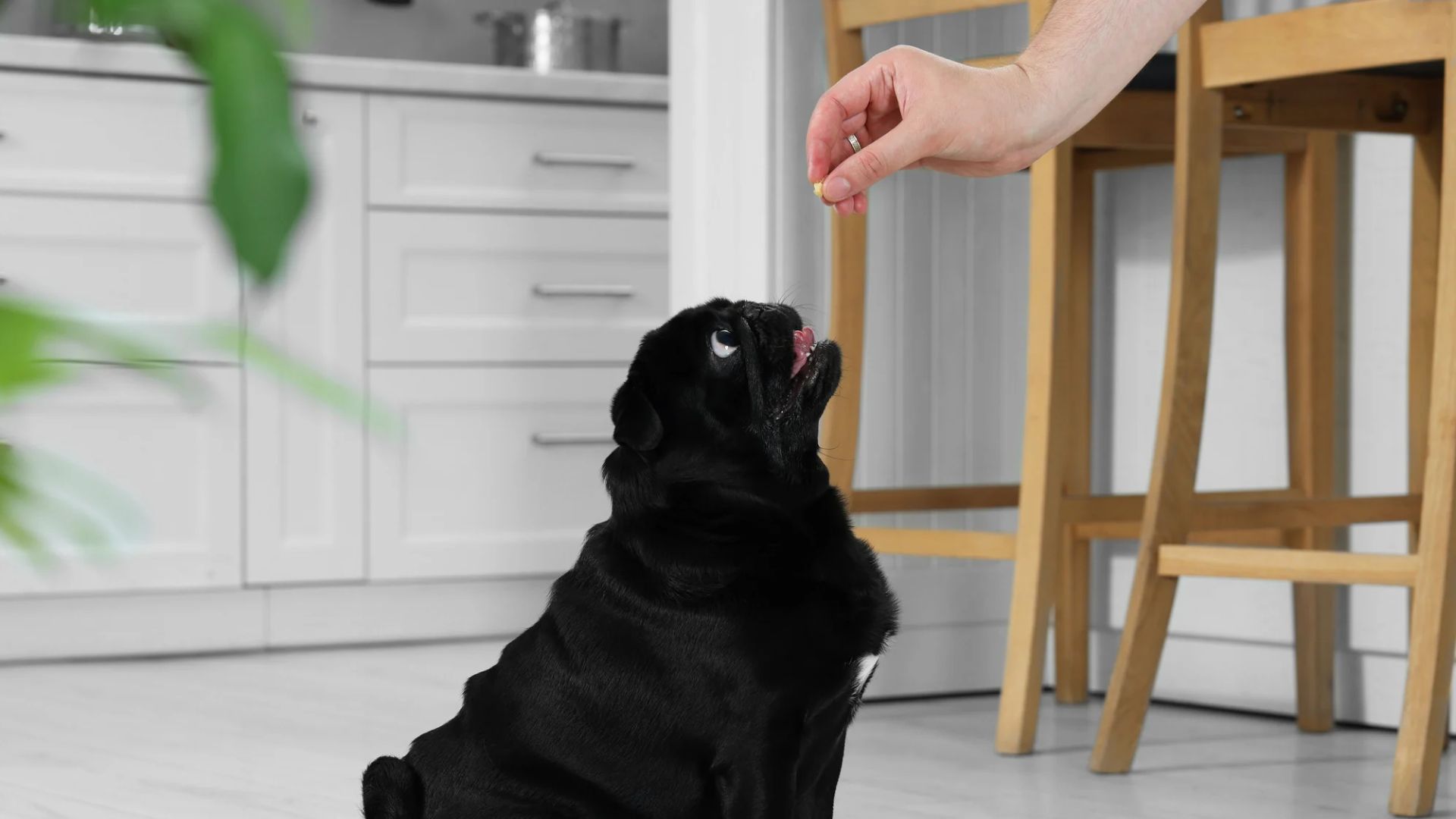
A dog who’s a few pounds heavy doesn’t look heavy to the people who love him. That’s not a character flaw. It’s just how it goes when you see the same dog every day. Veterinary teams assessed dogs across the U.S. in 2022, and 59% were overweight or had obesity, up from 56% a few years earlier.
The good news is that weight is one of the few health problems you can do something about at home, with a measuring cup, a little planning, and a bit more time moving together.
Check your dog’s shape, not just the number
The scale helps, but a dog’s ideal weight depends on breed, frame, and muscle. Vets use a body condition score instead, usually on a 1 to 9 scale where 4 or 5 is ideal. You can do a rough version yourself:
| Check | Ideal (4 to 5) | Carrying extra (6 and up) |
|---|---|---|
| Ribs | Easy to feel with light pressure, a thin layer over them | Hard to find, or you have to press |
| Waist (from above) | A clear tuck behind the ribs | Straight sides, or wider at the belly |
| Belly (from the side) | Tucks up toward the back legs | Level or hanging |
Thick coats hide a lot, so go by your hands more than your eyes. The WSAVA body condition chart has pictures of each score, and your vet can tell you exactly where your dog lands and what his goal weight should be.
Some breeds gain weight more easily
Any dog can get heavy, but some get a head start. A large UK study of more than 22,000 dogs found the breeds most likely to be overweight, compared with mixed breeds, were pugs, beagles, golden retrievers, and English springer spaniels, followed by border terriers, Labs, and Cavalier King Charles spaniels. A US study adds cocker spaniels, dachshunds, Dalmatians, Rottweilers, and Shetland sheepdogs.
Labs have a genetic reason. About a quarter of them carry a gene change that makes them hungrier and burn fewer calories. If your Lab acts like he’s starving, he may honestly feel that way. That’s a reason to be firm about portions, not a sign he needs more food.
Getting fixed and reaching middle age raise the odds too, so revisit portions after either one.
Why a few pounds matter
In a 14-year study of Labrador Retrievers, dogs fed to stay lean lived a median of 1.8 years longer than their littermates, and needed treatment for osteoarthritis about three years later. Extra weight also adds to the risk of diabetes, breathing trouble, and joint injuries, and it makes arthritis harder to manage once it shows up.
Measure the food
Most weight gain starts with the scoop.
- Use a real measuring cup, and level it off. A coffee mug or a heaping scoop can hold a lot more than the feeding chart means. The chart on the bag is written for a standard 8-ounce measuring cup. My favorite dog scoop is an old metal measuring cup I rescued from a family garage clean-out years ago, with the lines stamped on the side, so it’s easy to fill to the same mark every time. If you don’t have one, a cup like this does the job.
- Feed for the weight your dog should be, not the weight he is. The chart on the bag is a starting point, and it’s often generous. Your vet can give you a daily calorie number.
- Count everyone’s contribution. This one’s the sore point at our house. The extras are safe foods, but a bite here and a piece there from the whole family adds up fast. Agree as a household on what the dog gets each day, treats and table food included.
- Skip free-feeding for a dog who’s gaining. Some dogs can handle a full bowl all day. Plenty can’t, and will eat whatever’s there. Set mealtimes so you know what he’s actually eating.
If your dog acts starved on less food, ask your vet about a weight-management formula. Those are built to keep a dog fuller on fewer calories while still covering his nutrients, which a plain smaller portion of regular food may not do. Our article on how to choose a healthy dry dog food covers how to read the label.
Treats count (more than you’d think)
The common veterinary guideline is that treats and extras should make up no more than 10% of a dog’s daily calories. For a lot of small dogs, that’s a few small biscuits, not a handful.
Some easy ways to stay under it:
- Break treats in half. Your dog cares about getting one, not how big it is.
- Use part of his kibble as training rewards and take that amount out of his meal.
- Share plain vegetables. Plain green beans and a little plain sweet potato are table foods we share with our own dogs. No butter, no seasoning, and no onions or garlic.
- Count the long-lasting chews as treats. Bully sticks, dental chews, and similar chews can carry a surprising number of calories.
- Not every reward has to be food. A walk, a game of tug, or a good belly rub works for most dogs, and it doesn’t cost a single calorie.
For more ideas, see our article on finding the right treats for an overweight dog.
Get moving together
Food does most of the work in weight loss, but movement keeps muscle on while the fat comes off, and it’s good for the people at the other end of the leash too. Start where your dog is. A heavy dog or an older dog may need short, easy walks before anything longer. In the country, that might be a slow lap of the fence line; in town, a couple of extra blocks. Our article on exercising with your dog has ideas for every energy level.
How fast is too fast?
Slow and steady is the goal. Veterinary weight-management guidelines aim for about 1% to 2% of body weight a week. For a 60-pound dog, that’s roughly half a pound to a pound. Losing faster can cost muscle and isn’t safe, especially for older dogs.
Weigh your dog every couple of weeks at the same time of day. Many vet offices let you stop in and use the scale for free. If the number stalls for a month, check the treats first, then call your vet.
When to call the vet first
Talk to your vet before starting a weight-loss plan if your dog:
- gained weight quickly without eating more
- seems tired, cold, or slow, or has thinning hair
- drinks or pees much more than usual
- has heart, kidney, or joint problems, or is on medication
Some medical conditions cause weight gain, and they need treatment, not a smaller bowl.
What about weight-loss medication? Prescription weight-loss drugs for dogs have come and gone. One of them, dirlotapide, was pulled from the European market by its maker, and even when it was sold it was meant to work alongside diet changes and exercise, not replace them. Skip anything sold online as a dog weight-loss pill or supplement, and leave medication to your vet.
Where to start
Helping your little buddy shed a few pounds comes down to four things: measure the food, count the treats, add a little more walking, and check your dog’s shape once a month. Most dogs will lose the extra weight slowly and steadily, and they’ll feel better long before they reach the goal.
Have a heavy cat, too? Cats need a gentler approach. See how to help your overweight cat lose weight.
Last updated: November 27, 2026
Originally published: August 19, 2011



Thanks for the great article Marie. I do take my Blue Healer to the dog park most days. He loves to run and run and run. Keva is only 2 and a half years , yet he is the fastest dog there!! People there say I should enter him in races and that he is faster than a Grey Hound!!!
Thanks for reading the article Catherine! After dealing with Dre’s weight gain and loss, I just felt compelled to share what I had learned with others. I’m glad to hear that Keva is a fast runner and loves to run. I wish Dreyfuss shared the same zest for running, but he’s more of a couch potato. That’s why I’ve had to really make an effort to get him to engage in more exercise. With regard to Keva’s speed, have you considered having him compete in agility? Who knows?… Maybe Keva might be a natural at it too!
This is so true! I know that, in the past, I have simply filled the food bowl whenever I see that it is empty; this is a bad idea! Not only was this too much food, but the food itself was not healthy. From what I have been able to tell, the vast majority of the dog food out there contains a large amount of ‘cereal’; this provides too many carbohydrates and not enough fiber or protein – a definite aid towards obesity. A good test to see what percentage of your dog’s food is ‘cereal’ is to soak the dog food in water; if the food swells up to 2x larger or more, there is an overwhelming amount of ‘cereal’ in the food.
Try a different dog food like Purina One; it has a good percentage of protein and fiber, as well as essential vitamins/minerals. It’s not super cheap, but worth it! You can almost always find good coupons for that brand; a good place to find pet food coupons and store deals is couponingforpets.com
Wow this is such a great article, Thanks for sharing it. I probably need to watch skip’s diet from now on. My dog is a terrier and he loves to eat, and sometimes becomes lazy when he is full. I wonder what to do with him. Should I take him to a veterinarian to check his health.
Thanks so much for taking the time to read it! Yes, it’s always a good idea to have your vet take a look at your terrier just to determine whether or not he’s at his ideal weight… especially if he’s been acting differently (lazy or lethargic) than normal.
What a decadent age we live in, America’s pets are facing an obesity epidemic, while thousands of people are starving in Africa.
Our 14 year old tom cat used to be obese when I first joined his household. After a couple of years, he became an outdoor cat. After the contaminated cat food scare a few years back, I changed his diet from dry cat food to raw chicken breast, chicken gizzards, hearts, and liver, and tuna with garlic, plus a little dry food for dessert. He is now a sleek and energetic brawler, who stays out all night and can run like the wind.
Thanks for the article, I’m actually dealing with an overweight dog myself. Currently, I’m taking steps to help him out. Things like more exercise, healthier foods, and feeding him the appropriate amount of pet food each day should definitely lead him to a healthier life.
I really enjoyed this article! I know how dogs and cats have different nutritional needs, but didn’t realize how different breeds have particular needs as well.
Determining healthy pet food is often easier said than done, however. I would argue that the percentages of moisture can be more important than just reading the ingredients. For example, canned food with 8% crude protein and 75% moisture actually has more physical protein than dry food with 27% crude protein and 10% moisture. The FDA suggests comparing dry and canned product content by multiplying the guarantees of canned products by 4.
If anyone wants some more info on pet care, check out my latest blog posts: https://mjenee.wordpress.com/
Nice post! I like to snack so it’s hard to tell my pup he can’t snack too 🙂 One thing you can do to promote better gastrointestinal health, therefore better weight management, is a pet probiotic such as Fortiflora. The other ideas are great as well, many of which would work for pets and humans alike!