
This article was fully rewritten in May 2026 based on current veterinary research, nutritionist guidance, and independent testing data. Talk to your vet before making significant changes to your dog’s diet, especially if your dog has health conditions.
I’ve had dogs my whole life. As a kid, there was always one in the house. As an adult, I’ve never been without at least one. In all that time, choosing what to feed them hasn’t gotten any easier. In fact, the bags have gotten louder, the claims more confident, and the options more overwhelming. What hasn’t changed is how little most of that front-of-bag noise actually tells you.
“Premium.” “Natural.” “Protein-rich.” “Vet approved.” None of those phrases are regulated. Any brand can print them.
jump to…
What’s regulated, and what actually tells you something useful, is the ingredient list and the nutritional adequacy statement. Most people walk past both of them on the way to the front-of-bag claims.
This article is about the back of the bag. How to read it, what to look for, and what to skip. There’s a label checker tool below you can use on any food you’re considering. The five brand picks at the end are examples of how these principles play out in practice.

The Bottom Line
- Ignore front-of-bag marketing: Terms like “premium,” “natural,” and “vet approved” are unregulated.
- Check the first ingredient: Ingredients are listed by pre-cooking weight. Always look for named animal proteins (like “chicken”), not vague terms like “meat meal.”
- Find the AAFCO statement: Ensure the food meets the nutritional floor for your dog’s specific life stage, ideally substantiated by real feeding trials, not just formulation.
- Weigh the grain-free debate: The FDA has investigated links between grain-free diets (specifically those high in legumes) and canine heart disease. If going grain-free, loop in your vet.
What the ingredient list actually tells you
Ingredients are listed by pre-cooking weight, heaviest first. That single fact explains more about a dog food than any marketing claim on the front of the bag.
A food with deboned chicken as the first ingredient weighs most of its formula toward an identifiable animal protein before cooking. A food with corn, wheat, or soy up front is weighing its formula toward plant-based ingredients, which means the protein percentage may be hitting a number on the Guaranteed Analysis panel but arriving from lower-quality sources.
Named proteins matter. “Chicken” means chicken. “Chicken meal” means dried, concentrated chicken. It delivers more protein per pound than fresh chicken because the water has been removed. Both are solid. “Poultry meal” or “meat meal” without naming the animal is a different story. You cannot trace it. The source could be anything, and in the pet food industry that ambiguity has a documented history of problems. In 2018, the FDA found contamination in dog foods, including the euthanasia drug pentobarbital, tied to vague, unnamed animal ingredient sourcing.
If the label does not name the animal, treat it as a yellow flag. That’s the filter I use.
By-products are not automatically bad. Named organ meats (liver, kidney, heart) are nutrient-dense and widely used in quality formulas. Veterinary nutritionists are generally comfortable with named by-products. “Animal by-product meal” without a named source is the version to avoid.
Watch for ingredient splitting. A brand can list “ground corn,” “corn gluten meal,” and “corn bran” separately to push each one lower on the list, even though corn is effectively the dominant ingredient. If you see the same base ingredient appearing in multiple forms in the first ten, add them up mentally.
The grain-free question
Grain-free dog food went from fringe to mainstream in about a decade. The premise, that dogs do better without grains, was largely a marketing position, not a veterinary one.
In 2018, the FDA opened an investigation into a potential link between grain-free diets and canine dilated cardiomyopathy (DCM), a serious heart condition. The investigation found that more than 90% of reported DCM cases involved grain-free foods, and 93% of those foods had peas, lentils, chickpeas, or beans listed prominently in the ingredients.
The FDA closed active updates in 2022 without establishing a definitive causal link. The science is still unsettled. What’s clear is that the concern is real enough that most veterinary nutritionists now recommend against grain-free diets unless there’s a specific medical reason, typically a confirmed grain allergy, which is less common in dogs than food marketing suggests.
If a food is grain-free and lists legumes in the first ten ingredients, that combination is worth discussing with your vet. It does not mean the food is dangerous. It means there’s an open question and your vet should know what you’re feeding.
What AAFCO actually means
The AAFCO nutritional adequacy statement is on almost every bag. It’s worth understanding what it does and does not say.
AAFCO is the Association of American Feed Control Officials. They set nutrient profiles for dog food, minimum and maximum levels of protein, fat, vitamins, and minerals for different life stages. A food that meets AAFCO standards is formulated to be complete and balanced for the stated life stage.
That’s the floor, not the ceiling.
There are two ways a brand can earn the statement. The first is formulation: a nutritionist calculates the recipe on paper and confirms it hits the nutrient targets. The second is feeding trials: real dogs eat the food and are tested to confirm the nutrients are absorbed and utilized. Feeding trials are harder to run and more meaningful. The label will say “Animal feeding tests using AAFCO procedures substantiate…” if feeding trials were conducted. If it says “formulated to meet,” that’s the paper method.
Both are legitimate. If you’re choosing between two otherwise comparable foods and one has feeding trial data, that’s the more rigorous claim.
One thing AAFCO does not do is test food. Ever. A widespread misconception is that the AAFCO statement means a product has been inspected or certified. It has not. AAFCO writes the rules. Manufacturers are responsible for meeting them. The statement on the bag tells you the formula was designed to be nutritionally adequate. It says nothing about what else might be in it: heavy metals, pesticides, industrial contaminants. That’s a completely separate question, and AAFCO was never designed to answer it.
Life stage matters more than most people realize. The AAFCO statement specifies the intended life stage: growth (puppy), adult maintenance, reproduction, or all life stages. Puppies need higher protein, fat, calcium, and phosphorus than adult dogs. Large breed puppies specifically need controlled calcium levels. Too much accelerates bone growth in ways that can cause joint problems later. Adult dogs need less of both. Senior formulas typically lower protein and calories, though some veterinarians now prefer keeping protein higher in older dogs to maintain muscle mass.
Match the food to your dog’s current life stage. “All life stages” meets the higher demands of puppies and pregnant dogs and works for adults too, but may run higher in calories than an adult maintenance formula needs. When in doubt, ask your vet whether a life-stage-specific formula makes more sense for your dog’s size and health history.
The “vet recommended” question

Most lists of the best dog foods are funded, directly or indirectly, by the brands they recommend. Online retailers publish “best dog food” guides and sell the foods they rank. Review sites earn affiliate commissions on the brands they feature. Veterinary schools receive research funding from pet food companies, the same companies whose products appear in vet recommendations. Purina and Mars Petcare together control roughly 61% of the US pet food market, and both invest heavily in veterinary research and education.
None of that makes every recommendation wrong. Purina, Hill’s Science Diet, and Royal Canin genuinely have strong research backing, board-certified nutritionists on staff, and feeding trial data. The WSAVA-aligned brands earned their veterinary reputation through decades of formulation science.
But the context matters. Consumer advocacy groups like Truth About Pet Food have used Freedom of Information Act requests to pull FDA adverse event data the agency does not publish proactively. In the first six months of 2024, the FDA received 1,705 reports of sick pets linked to Purina products and 119 linked to Mars Petcare brands. Adverse event reports are unverified complaints, not confirmed cases, and a brand’s market scale affects absolute numbers. The data exists, it’s public record, and it’s worth knowing when “vet recommended” is the primary reason you’re choosing a food.
How to research a brand independently
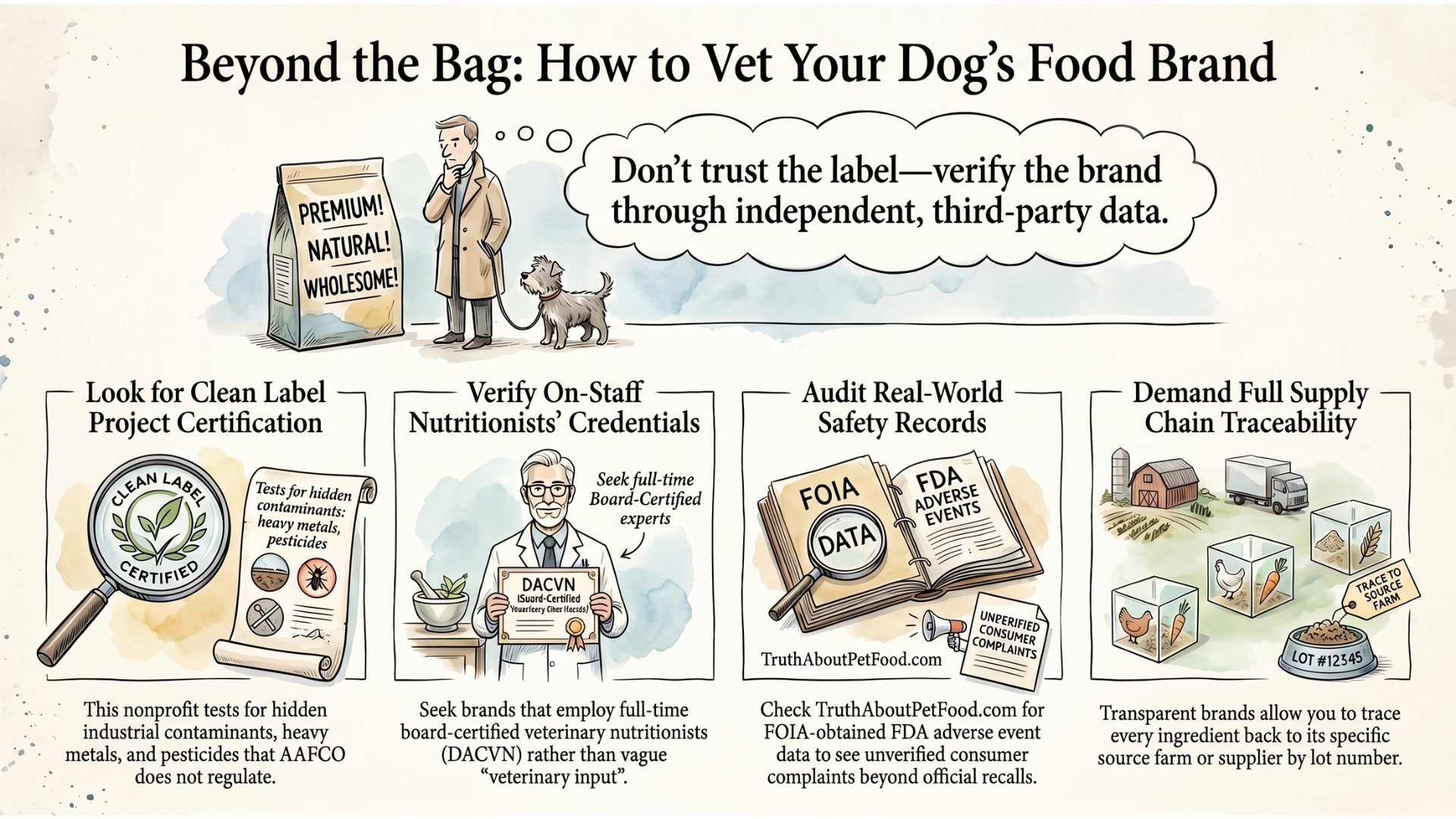
Four things worth checking on any brand you’re seriously considering:
1. Clean Label Project certification. The CLP is a nonprofit that uses ISO-accredited labs to test pet foods for more than 100 industrial contaminants, heavy metals like lead, arsenic, and mercury, pesticides, BPA, phthalates, and acrylamide. None of these will ever appear on an ingredient label. Brands that score in the top tier can earn a Purity Award. This is independent, third-party, lab-verified data. It tests for the things AAFCO was never designed to catch.
2. Named credentialed nutritionists. “Formulated with veterinary input” is not the same thing as having full-time board-certified veterinary nutritionists (DACVN or DACVIM) or PhDs in animal nutrition on staff. Dig into the brand’s website and look for named people with verifiable credentials. If the website is vague about who formulates the food, that’s a signal.
3. FDA adverse event data. TruthAboutPetFood.com publishes FOIA-obtained FDA adverse event data by brand. It’s not a perfect system. Reporting is voluntary and inconsistent. But it’s the closest thing to a real-world safety record available outside of recalls.
4. Supply chain traceability. A brand that can trace every ingredient to its source farm or supplier by lot number is operating at a different transparency level than one that cannot. Some brands offer this on their website. Most do not.
Check any dog food label
Get a plain-language read on any dry dog food in seconds.
Type what you see on the bag and answer four quick questions. Hit Check this food when you’re ready.
Ingredients are listed by weight, heaviest first. Find the ingredient list on the back or side panel and enter the first ingredient you see.
Count down the ingredient list on the back panel. If any of these appear within the first 10 items, select Yes. If you see them further down or not at all, select No.
Find the Guaranteed Analysis panel, usually a small table on the back or side of the bag. Look for “Crude Protein” and enter the minimum % listed.
Look for a sentence near the Guaranteed Analysis panel. It will say something like “formulated to meet the nutritional levels established by AAFCO” or “animal feeding tests using AAFCO procedures substantiate…” If you cannot find any sentence mentioning AAFCO, select the third option.
“Grain-free” is almost always on the front of the bag as a marketing claim. If you do not see it there, check the ingredient list for oats, brown rice, barley, or wheat. This question works together with the legumes question above. The FDA’s DCM investigation found the concern was specific to grain-free foods that also list legumes prominently. If this food is grain-free, your answer to the legumes question becomes more important.
5 brands that hold up to scrutiny
These five cover different price points and formulation philosophies. They’re examples of what the label-reading principles above look like in practice. Your dog’s specific needs, health history, and what they’ll actually eat matters more than any list.
Each brand offers multiple formulas, so when you land on the Chewy brand page, filter by your dog’s life stage and size to find the right fit.
1. Purina Pro Plan
Purina Pro Plan is the most consistently recommended brand by veterinary nutritionists, and the recommendation has substance behind it. Purina employs more than 500 scientists, veterinarians, and nutritionists. Pro Plan formulas are substantiated by feeding trials, and the brand has published peer-reviewed research on canine nutrition for decades.
It’s not a boutique brand with a compelling origin story. It’s a large corporation doing rigorous formulation science, and that track record is worth something.
Worth knowing: in the first six months of 2024, the FDA received 1,705 adverse event reports linked to Purina products, more than any other manufacturer in that period. Adverse event reports are unverified complaints, and Purina’s market dominance means the raw numbers run high. But it’s part of why independent verification matters alongside vet recommendations.
— Find Purina Pro Plan on Chewy
2. Orijen

Orijen is the most ingredient-intensive dry food on this list. Up to 85% of the formula consists of fresh or raw animal inclusions, muscle meat, organs, cartilage, and whole fish. The philosophy is “biologically appropriate” nutrition: formulas designed to reflect what dogs would eat in the wild. Veterinary nutritionists who prioritize whole-food sourcing over synthetic vitamin supplementation point to Orijen.
Orijen is grain-free and protein-dense, which means the grain-free/legume consideration discussed above applies. Check the specific recipe’s ingredient list for legume positioning before committing. Champion Petfoods, the Canadian company behind Orijen, has maintained strong quality control and sourcing transparency. It’s also the most expensive brand on this list.
3. Merrick Healthy Grains
Merrick’s Healthy Grains line places well with veterinarians for dogs with sensitive stomachs or poultry allergies, and it sidesteps the grain-free/legume question entirely. Deboned meat leads the ingredient list. The formulas are manufactured in Texas and include leading levels of glucosamine and chondroitin for joint support, which is unusual in a dry food at this price point.
Worth knowing: Merrick is owned by Purina, which acquired them in 2015. That brings Purina’s manufacturing standards to Merrick’s recipes. The Healthy Grains line is a cleaner recommendation than their grain-free formulas given what the current research says.
—Find Merrick Healthy Grains on Chewy
4. Wellness Core

Wellness Core sits at the intersection of ingredient quality and accessibility. It’s available at most major pet retailers, priced below Orijen, and consistent about leading with named animal proteins. The brand has a long track record and stable formulas.
One honest note: Wellness has a more mixed recall history than its marketing suggests. Thiamine-related recalls, moisture and noncompliance events, and manufacturing issues have come up over the years. The brand is now under the Wellness Pet Company banner backed by Clearlake Capital after the WellPet rebrand. Not disqualifying, but worth knowing. The grain-free Core formulas carry the same legume consideration as Orijen.
5. Hill’s Science Diet

Hill’s Science Diet is the clinical credibility option on this list. It’s the brand most likely to be stocked at your vet’s office, and that relationship exists for a reason: Hill’s has deep formulation research, full-time board-certified veterinary nutritionists, and extensive feeding trial support across their product line.
It does not have a premium ingredient story. The formulas lean on research and digestibility over exotic proteins and marketing-friendly ingredient lists. For dogs with specific health conditions, sensitivities, or life stage needs, Hill’s covers more clinical bases than most brands on this list.
One honest note: Hill’s, like Purina, is a major corporation with significant ties to veterinary research funding. The “vet recommended” label reflects genuine scientific credibility and financial relationships at the same time. Both things are true.
— Find Hill’s Science Diet on Chewy
Worth knowing about: brands outside the major retailers
A few brands earn consistent mentions from independent researchers and the Clean Label Project but are not available on Chewy. No affiliate relationship here, just editorial mentions worth following up on.
Open Farm offers 100% ingredient traceability by lot number and earned the Clean Label Project Purity Award for significantly lower heavy metal and contaminant levels than industry averages. Their Ancient Grains line sidesteps the grain-free/legume issue entirely. No recalls as of this writing. Find them at openfarmpet.com.
Freshpet is the only brand to have its entire product line earn the Clean Label Project Purity Award. Refrigerated, not dry kibble, but worth knowing if you’re open to formats beyond traditional dry food. Find them at freshpet.com.
JustFoodForDogs uses USDA-certified human-grade ingredients and is one of the only fresh brands to offer veterinary prescription diets for kidney, liver, and other conditions. Recipes are validated through independent university research. Find them at justfoodfordogs.com.
Finding the right formula on Chewy
The brand picks above are starting points. The right formula depends on your dog’s size, age, and any health considerations your vet has flagged.
Why Chewy? Because Chewy has earned a different kind of trust than most pet retailers. Their customer service is genuinely legendary. If you’ve ever had them send you a handwritten card when a pet died, you know what I mean. What you might not know is that they have curated landing pages built around actual veterinary panels, not just whatever brand paid for top placement.
Their highest-quality dry dog food page is a solid starting point for exactly that reason. From there, use the filters on the left to narrow by life stage, breed size, special diet, health feature, and price. Start with those filters, run any finalist through the label checker above, and you’re making a more informed decision than most people do.
Browse Chewy’s highest-quality dry dog foods
The honest answer
There is not a single best dry dog food. There’s a best dry dog food for your dog, your budget, and what you and your vet know about your dog’s health.
I’ve bought a lot of dog food over a lot of years. What I’ve landed on is this: the loudest bag is rarely the best food. Do the label work, ask your vet, and trust what you see over what the front of the bag says. If your dog is doing well on it, that’s the answer.
Last updated: May 11, 2026
Originally published: May 25, 2017