
A fresh dog pee spot gives you a place to start. It gets trickier when the carpet looks clean but the smell lingers or comes back. What you do next depends on whether you’re cleaning up a fresh accident or tracking down an older one.
Quick answer: For fresh dog urine, put a folded white towel over the spot and stand on it. Your weight helps soak up as much urine as possible before it settles deeper into the carpet. Lift the towel, switch to a dry section, and repeat until no more moisture comes up. Don’t rub or scrub. Then use a carpet-safe pet urine cleaner according to the label and let the area dry completely before checking for any lingering smell.
We've cleaned up our share of dog accidents, and one rule has held up every time: blot immediately. Before you think about which cleaner to use, get as much of the fresh urine up with a towel as you can.
Jump to…
How Do You Clean Fresh Dog Urine From Carpet?
1. Guide your dog to their bathroom spot
If you catch your dog starting to pee indoors, calmly get their attention and guide them to their usual bathroom spot. If they finish there, praise them. Then come back and blot the carpet. If you find the accident after it's over, just clean it up.
There’s no need to scold them after the fact. It won’t teach your dog where to go or prevent another accident; it may just teach them to sneak off next time.
2. Blot up as much urine as you can
If there’s solid waste too, lift it away first without pressing it into the carpet.
Lay a folded, clean white microfiber towel over the wet spot. If the area is large enough, stand on the towel and let your weight do the pressing. Move to a dry section or grab another towel, and keep going until it comes back dry or close to it. Paper towels work too, but in our experience microfiber picks up more moisture. Press and lift. Never rub.
As you blot, check around the visible spot with a dry section of towel. If it picks up moisture, keep moving outward. A white towel also makes it easier to see whether any carpet dye is coming up.
3. Choose a cleaner that suits your carpet
Check your carpet’s care instructions if you have them, especially for wool, vintage rugs, or specialty carpet. Test the cleaner somewhere out of sight first. A product labeled for carpet may still be wrong for your carpet.
For a small accident, we’d start with a cleaner made for pet urine before considering a machine. Enzyme cleaners can help break down urine residue instead of just covering the smell with fragrance. Rocco & Roxie Professional Strength Stain & Odor Eliminator and Nature’s Miracle dog formulas are two options to consider. Check the directions for the exact formula you choose.
Stick with one treatment. Adding vinegar, carpet shampoo, or another cleaner on top makes it harder to tell what worked and may leave residue behind.
4. Treat the spot and give the cleaner time to work
Use the area you found while blotting as your starting point. Apply the cleaner across that area and its edges, rather than spraying only the darkest part of the stain.
Follow the bottle’s directions for how much to apply and how long to leave it. Check whether it gives different instructions for a stain and for a deeper odor. There’s no universal 15-minute rule: some treatments need enough product to reach urine beneath the carpet, while others call for a lighter application.
5. Finish as directed, then check after it dries
Follow the label’s next step. One cleaner may tell you to blot after a set time; another may tell you to leave the treated area to air-dry. Rinse or extract only if the product and carpet instructions call for it.
Keep pets off the treated area for as long as the label says. Once the carpet is completely dry, check the smell again. If your dog has used that spot before and the odor returns, older urine may still be in the backing or pad.
When the Dog Urine Smell Comes Back After Cleaning
If the smell comes back after the carpet is completely dry, find out where it’s strongest before treating anything again. You may have to get your nose closer to the carpet than you’d like. Sniff the spot you cleaned, its edges, the baseboard, and nearby furniture or hanging fabric.
If the smell is strongest where you already cleaned, urine may still be in that area. The carpet fibers are only the top layer; urine can spread into the backing or pad. The Carpet and Rug Institute notes that an odor can become noticeable again in humid weather. Check whether your pet-urine cleaner has separate directions for lingering or deep odors, and follow those before trying a different product. If several careful treatments haven’t worked, a professional who handles pet urine may be able to treat the deeper layers or assess whether the pad needs attention. Urine reaching the pad does not automatically mean it needs replacing.
Remember the Febreze ads about going “noseblind” to smells in your own home? Spend enough time in a room, and you may stop noticing a smell even though it’s still there. Walk back in, and you catch it again. Researchers call this olfactory adaptation. Notice when the smell hits you, but use your nose up close to work out where it’s coming from.
If the smell is stronger somewhere else, there may be another accident you haven’t cleaned. You might not see a stain if it has already dried. The next step is to find that spot and treat it.
How Do You Find and Clean Dried Dog Urine From Carpet?
You can’t blot up a dried accident the way you can a fresh one. First, you need to find where the urine is. The carpet may smell even when there’s no obvious stain.
Find the source
Look for discoloration or a patch that feels stiff. Check places your dog spends time, along the edges of rooms, and near furniture. Don’t stop at the carpet: urine on a baseboard, furniture leg, or hanging fabric could be causing the smell.
A UV pet-urine flashlight may help you spot something you’ve missed. Scan slowly in a dark room, then turn the lights on and inspect anything that glowed. Other spills and cleaners can glow, too, and a spot may still be there even if the light shows nothing. Use it as a clue, not proof.
We haven’t tried a UV flashlight ourselves, so we can’t say how well one will work on a particular carpet. You don’t need one for an accident you can already see. But when that pee smell hits you every time you walk into a room and you still can’t find the spot, a light may be worth trying before you clean more carpet on a guess.
Treat the spot
Once you’ve found a likely spot, use a pet-urine cleaner that’s suitable for your carpet. Check the directions for odor elimination or deep odor problems, not just stain removal. On the two cleaners mentioned earlier, those are separate sets of instructions. The amount to apply, wait time, and whether to blot afterward can differ, so follow the label on the cleaner you’re using.
Let the area dry completely before checking it again. If the smell still comes from that spot after treatment, urine may have reached the backing or pad. A carpet-cleaning professional can help determine whether those layers need attention.
When Does a Portable Carpet Cleaner Help?
For one small accident, towels and a pet-urine cleaner may be enough. A portable carpet cleaner becomes useful when you’re dealing with repeat spots, carpeted stairs, or upholstery that’s safe for wet cleaning. It sprays solution and pulls dirty liquid back out.
We favor corded machines for this kind of job because there’s no battery to run down mid-cleanup. We’ve had good experiences with BISSELL as a brand, and we appreciate the work of the BISSELL Pet Foundation, founded by Cathy Bissell.
BISSELL Little Green Pet Pro Portable Carpet Cleaner
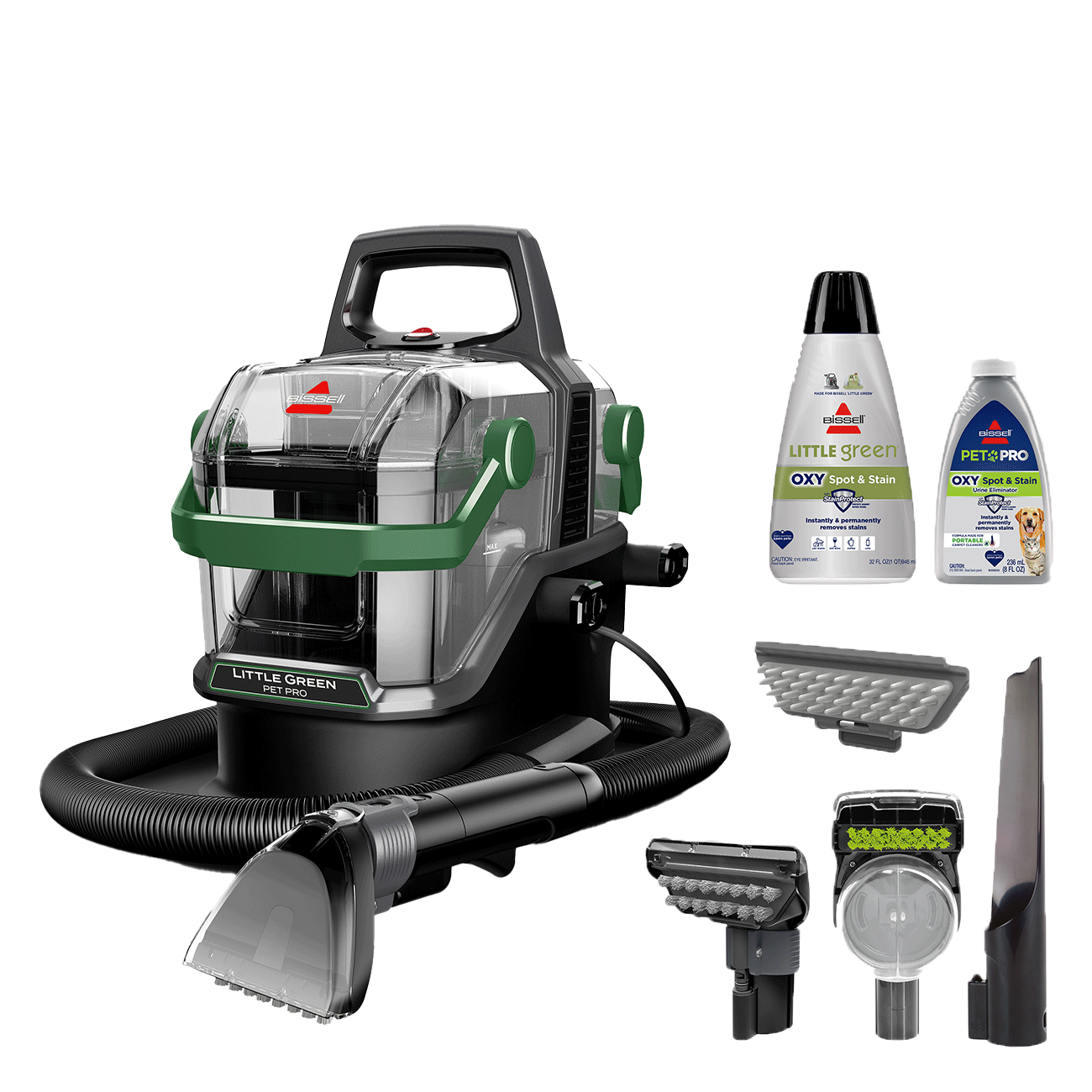
Best for: Repeat spot cleanups, carpeted stairs, and upholstery that’s safe for wet cleaning.
This corded cleaner sprays solution onto a spot and pulls dirty liquid back out. The exclusive bundle includes a Stain Trapper Tool for particularly messy jobs.
- 64-ounce clean tank and 48-ounce dirty tank
- 5-foot hose for stairs and furniture
- 13 pounds, with a carry handle
Do You Need a Full-Size Carpet Cleaner?
A full-size machine makes more sense if you regularly clean whole carpeted rooms, along with the occasional spot or stair. If you only need to clean a room once, consider renting a carpet cleaner before buying one.
BISSELL Big Green PET PRO Carpet Cleaner
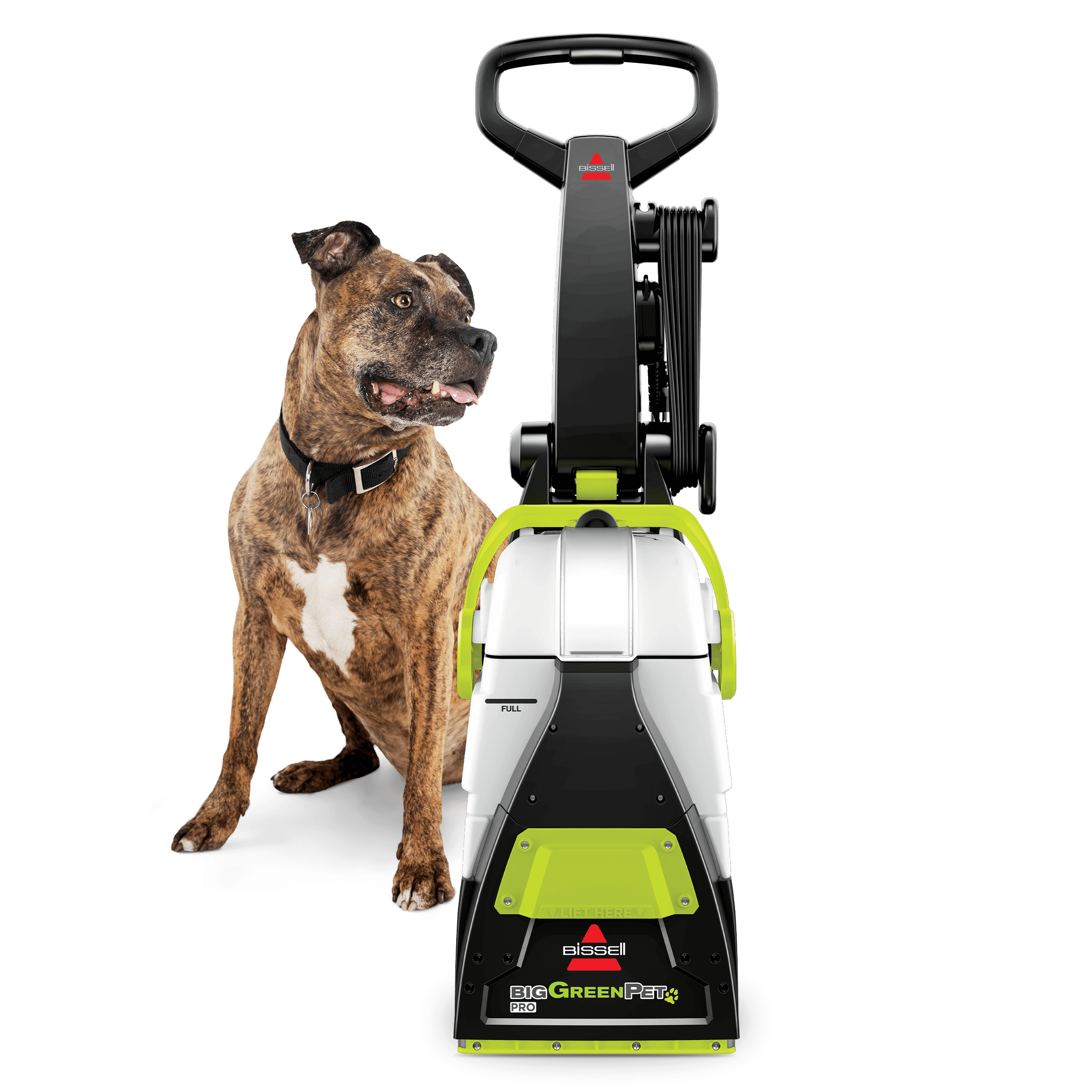
Best for: Whole carpeted rooms and households that use a carpet cleaner regularly.
This corded, full-size cleaner covers more carpet per pass than a portable spot cleaner. Its hose and included tools also reach stairs and upholstery.
- 1.75-gallon clean and dirty tanks
- 10.5-inch cleaning path
- 9-foot hose; machine weighs 44 pounds
Can You Use a Steam Cleaner on Dog Urine?
People often call carpet-cleaning machines “steam cleaners” even when they don’t produce steam. The BISSELL machines above spray solution and pull liquid back out. Rug Doctor says its rental carpet cleaners work without steam, too. You can use that type of machine on a urine spot if your carpet, machine, and cleaning formula instructions allow it.
If you mean a machine that applies actual steam, skip it for the urine spot. Blot and use a carpet-safe pet-urine cleaner instead. Scott, the paper products brand, warns that steam heat can cause urine proteins to bond to carpet fibers, making the stain harder to remove.
Do Home Remedies Work on Dog Urine in Carpet?
Vinegar, baking soda, hydrogen peroxide, salt, and dish soap all show up in advice for cleaning dog pee. Some may help with part of the job, but there isn’t one homemade method that suits every carpet or every accident.
- Dish soap, followed by vinegar: The Carpet and Rug Institute’s method starts with ¼ teaspoon of bleach-free, lanolin-free liquid hand dishwashing detergent mixed with one cup of lukewarm water. Blot with paper towels dampened in the solution, absorb the moisture with dry towels, then rinse with warm water and blot again. Repeat while the spot is improving. After those steps, blot with a mixture of one cup white vinegar and two cups water. Cover the area with a thick layer of white paper towels, weigh them down with something that won’t transfer color, and change them until the carpet is dry.
- Vinegar alone: Diluted vinegar appears in carpet-cleaning advice, but the guidance isn’t consistent. The Carpet and Rug Institute uses it as one step in the procedure above. Humane World for Animals advises against vinegar, saying its strong smell may encourage a pet to mark the area again. We wouldn’t assume vinegar by itself will solve a urine stain or a smell that keeps coming back.
- Baking soda and carpet powders: Once you’ve cleaned the urine and the carpet is completely dry, a light sprinkle of plain baking soda may help with lingering odor. Leave it for about 15 minutes, then vacuum thoroughly; Arm & Hammer also suggests leaving it overnight. Scented carpet powders serve a similar freshening purpose, but follow their package directions and use them sparingly. Fine powder can remain in carpet or clog some vacuums. Baby powder gets suggested online, too, but we haven’t found a reason to choose it over baking soda for this job.
- Vinegar and baking soda together: Scott describes a recipe that adds baking soda and vinegar solution to a wet urine spot and scrubs it into the carpet. The fizz shows that the ingredients are reacting; it doesn’t show that the urine is gone. We’d skip the scrubbing, which also goes against our advice for handling a wet spot, and wouldn’t choose this mixture over a carpet-safe pet-urine cleaner.
- Hydrogen peroxide alone: Peroxide can help with some stains, but it can also lighten carpet dye. A peroxide-based cleaner labeled for carpet gives you directions for that surface; household peroxide does not. PetMD recommends testing a peroxide-based cleaner in a hidden spot before using it on a urine stain.
- Hydrogen peroxide and baking soda together: You’ll find recipes that combine these, sometimes with dish soap. It’s a different mixture from peroxide alone, and the bubbling isn’t a reliable test of whether it removed urine. Because peroxide may affect carpet color, we wouldn’t offer a homemade recipe for an unknown carpet. If you want to try a peroxide treatment, a product labeled for your carpet is easier to use as directed.
- Salt: We’d skip table salt on a urine spot, whether it’s fresh or already been cleaned. It may absorb some surface moisture, but it can dissolve in damp carpet and leave residue. Some carpet powders contain sodium sulfate, a different salt from table salt (sodium chloride). Those powders are intended to freshen carpet, not draw urine out of a wet spot.
- Chlorine bleach: Skip it for a dog-urine spot, even diluted. It can discolor carpet and damage its fibers or backing.
- Ammonia, laundry detergent, and automatic dishwasher detergent: Don’t substitute these for liquid hand dish soap in the method above. Humane World advises against ammonia on pet-urine spots because its strong smell may encourage marking. The Carpet and Rug Institute says not to use laundry or automatic dishwasher detergent in its carpet procedure; those products may contain ingredients that affect carpet fibers or dye.
Finish one treatment and let the carpet dry before deciding whether to try another. Even established sources disagree about some home remedies, so read the full method and check your carpet’s care instructions before trying one.
If you switch methods, check whether the first cleaner needs to be rinsed or removed. Don’t layer a household remedy over an enzyme cleaner that’s still working, and don’t mix cleaning products unless their directions specifically say to. Some combinations can produce harmful gases or corrosive substances, as this guide to cleaning products you should never mix explains.
When Home Cleaning Is Not Enough
If the smell still returns after several careful attempts, especially in a spot your dog has used more than once, consider calling a carpet professional who handles pet urine. Tell them what you’ve already tried and ask whether they can treat the odor beyond the carpet fibers.
Urine in the pad isn’t automatically a lost cause. Depending on how far it spread, deeper treatment may work, or the affected pad may need replacing. If the floor beneath is involved, that may need attention too. Ask what they can assess and treat before booking a standard whole-room cleaning.
If a normally housetrained dog suddenly starts having accidents, or the accidents keep happening, check with your vet. Cleaning the carpet won’t address a medical reason for the change. VCA Animal Hospitals discusses possible causes of house soiling.
Last updated: September 25, 2026
Originally published: October 25, 2018